


Highlights
A forgotten 0.6L vessel holds one key to global water conservation
Muslims use up to 10L per wudu. The Prophet used 0.6L. The gap costs billions
Abundance makes you forget the setpoint. Scarcity teaches you precision
WAYAKIT saved 5M liters using the same principle: minimum viable resource
The Mudd Test: What’s the gap between what you use and what’s actually enough?
👋 Hi, it’s Luisa Javier. Welcome to Aziul Connections ( 🌎🔬The Sustainable Systems Lab), where I study how sustainable systems are built for business, leadership, and life.
If you want to learn how to apply systems to build a successful, peaceful, and conscious life, subscribe to the lab.
🎧 Listen to Luisa read this article
Nobody knows what a mudd is.
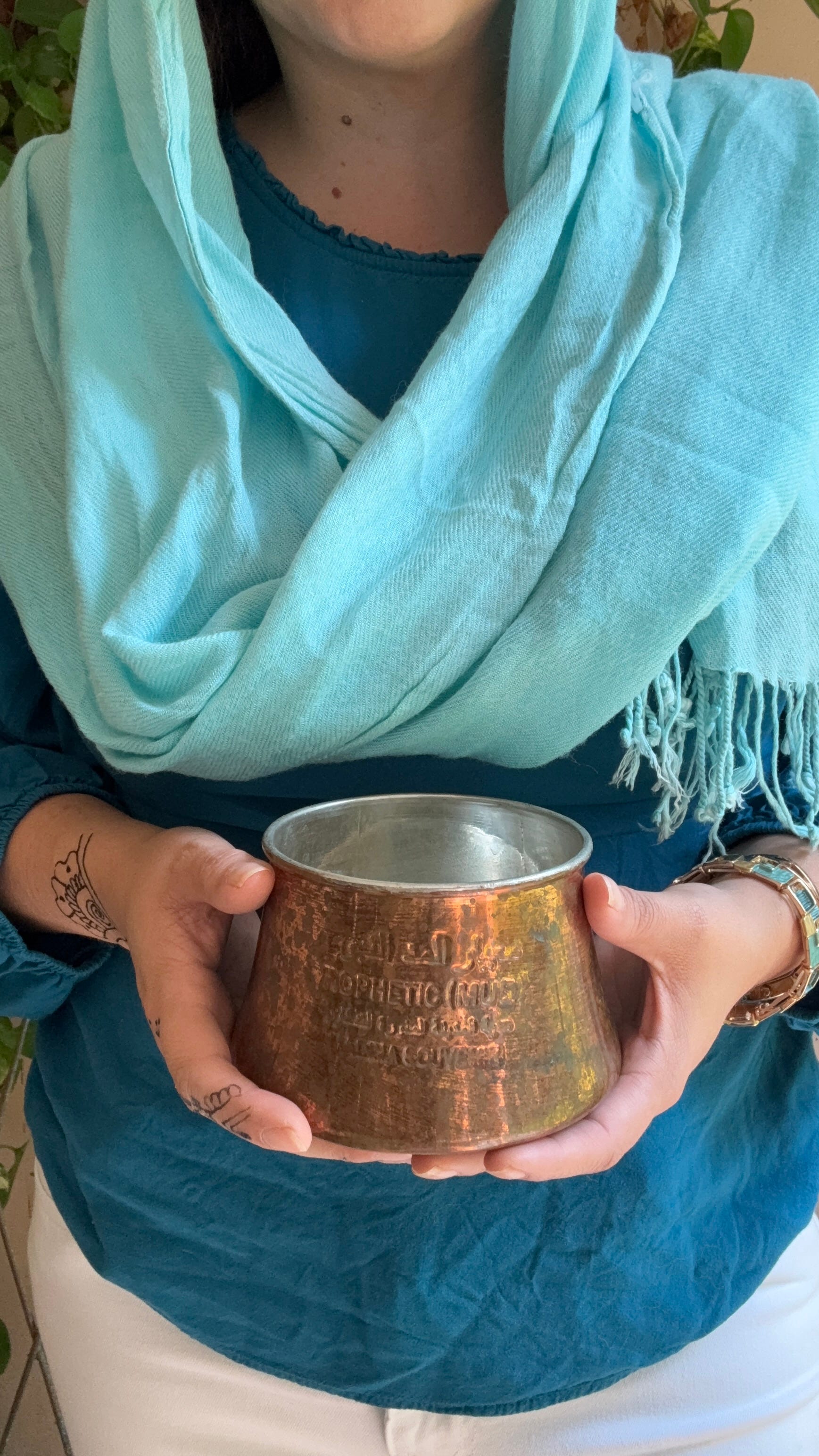
I learned that the hard way, standing in the old market of Madinah, holding up a picture on my phone and asking shopkeeper after shopkeeper if they had one. Most looked at me with polite confusion. A few thought I was looking for mud, the dirt kind. One man pointed me toward the souvenir section near the back of his shop, where I finally found it: a small copper vessel, stamped with the words “Prophetic Mudd” and “Madina Souvenir,” sitting between decorative prayer beads and miniature mosque replicas.
A decorative object. Its original purpose, apparently, forgotten.
I bought it. I held it in my hand. And I kept thinking about the conversation that had sent me searching for it in the first place.
The gathering
It started the way most important things in my life start: not in a lab, not in a boardroom, but in a regular conversation with a friend.
Nora Al Jindi had just come back from UK. She had spent time at the Oxford Centre for Islamic Studies with Professor Shahid Jameel, a biochemist who spent decades studying viruses before turning his research toward something that puzzled him more: why Muslim societies, despite having one of the richest ethical frameworks around resource stewardship in history, were struggling so much with environmental practice.
His work sits at the intersection of faith-based sustainability and applied climate science, a combination that almost nobody in mainstream sustainability discourse is taking seriously enough.
Nora mentioned his work on water. Specifically, on a daily ritual that 1.8 billion Muslims on Earth perform up to five times a day.
And then she said the number.
I want to pause here because something about that moment matters beyond the data. Two women in Saudi Arabia, one Saudi, another Mexican, sitting together in an ordinary gathering, passing knowledge that had not traveled through any formal institutional channel. No conference. No journal. No policy brief. A professor in Oxford had documented the research, a woman named Nora had attended his lecture, and she brought it to me. That is how this information moved. The World Water Day 2026 theme — “Where Water Flows, Equality Grows (Water and Gender)” — carries a quiet truth that I recognized in that room: water knowledge, like water itself, does not reach everyone equally.
I asked her to introduce me to the professor. I needed to understand it. More than that, I needed to share it.
What happens five times a day
Before every prayer, Muslims perform a ritual purification called wudu, or ablution. A precise sequence: washing the hands, rinsing the mouth and nose, washing the face, washing the arms up to the elbows, wiping the head, cleaning the ears, washing the feet. Each step has a specific order and intention behind it. Not a shower. A designed ritual, with defined inputs and a clear purpose: to arrive at prayer in a state of physical and spiritual cleanliness.
Hadith from Sahih al-Bukhari records that the Prophet Muhammad dedicated an entire chapter of his guidance to the act of performing ablution: its steps, its limits, and its relationship to waste. The chapter title is explicit: performing ablution with one Mudd of water. Prophet Muhammad water conservation was never vague. It was measured.
Most people who are not Muslim have never heard of wudu. Most Muslims have never questioned how much water it actually requires.
I converted a few years ago. I came to the faith as a water scientist, which meant I asked a lot of questions about what the tradition actually prescribed in terms of Islamic water conservation. How many repetitions for each step? What exactly counts as clean? What is the correct sequence?
What I never thought to ask was: how much water is enough?
I was doing it with the tap fully open. Water running the whole time. Three passes for each body part. I assumed that was what the ritual required, because nobody had told me otherwise, and because in the mosques of Madinah, where I have gone for prayer, everyone around me seemed to be using at least as much. Tap water running freely, the sound of it constant, the sense that water was the one thing in infinite supply.
In Saudi Arabia, water scarcity is easy to forget because it rarely shows up in daily life. I had absorbed that sense of effortless abundance without questioning it. The system had trained me to treat conservation as an anomaly, not the default.
The 0.6-liter shock: a forgotten measurement with modern consequences
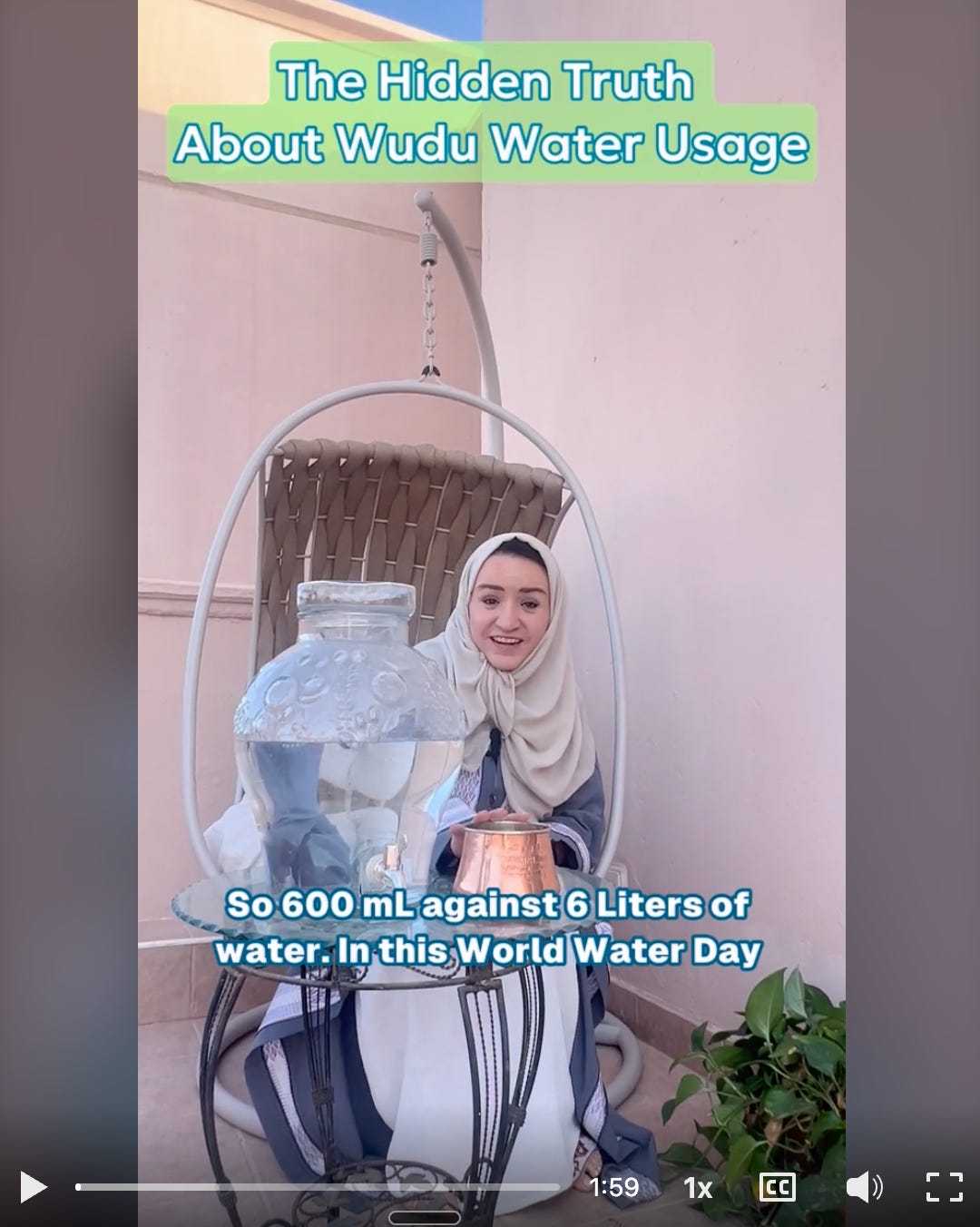
A mudd is a unit of measurement from the time of the Prophet Muhammad, peace be upon him. Roughly 0.6 liters. About the size of a large coffee cup.
But how much water is spent in wudu today?
Research published across multiple peer-reviewed studies tells us what most Muslims actually use today. A comprehensive 2017 study in Applied Water Science by Zaeid analyzed water use and time during ablution from taps, finding that more than 20% of ablution water is used for washing of feet and the largest water waste occurs during washing of face portions.
Numbers across studies range from 3 liters to 10 liters per session depending on location and method. For example, there is comprehensive PhD thesis by researcher Alia Alawi “Water demand management in mosques in Oman”. Participants using a modern tap averaged 7 liters per session.
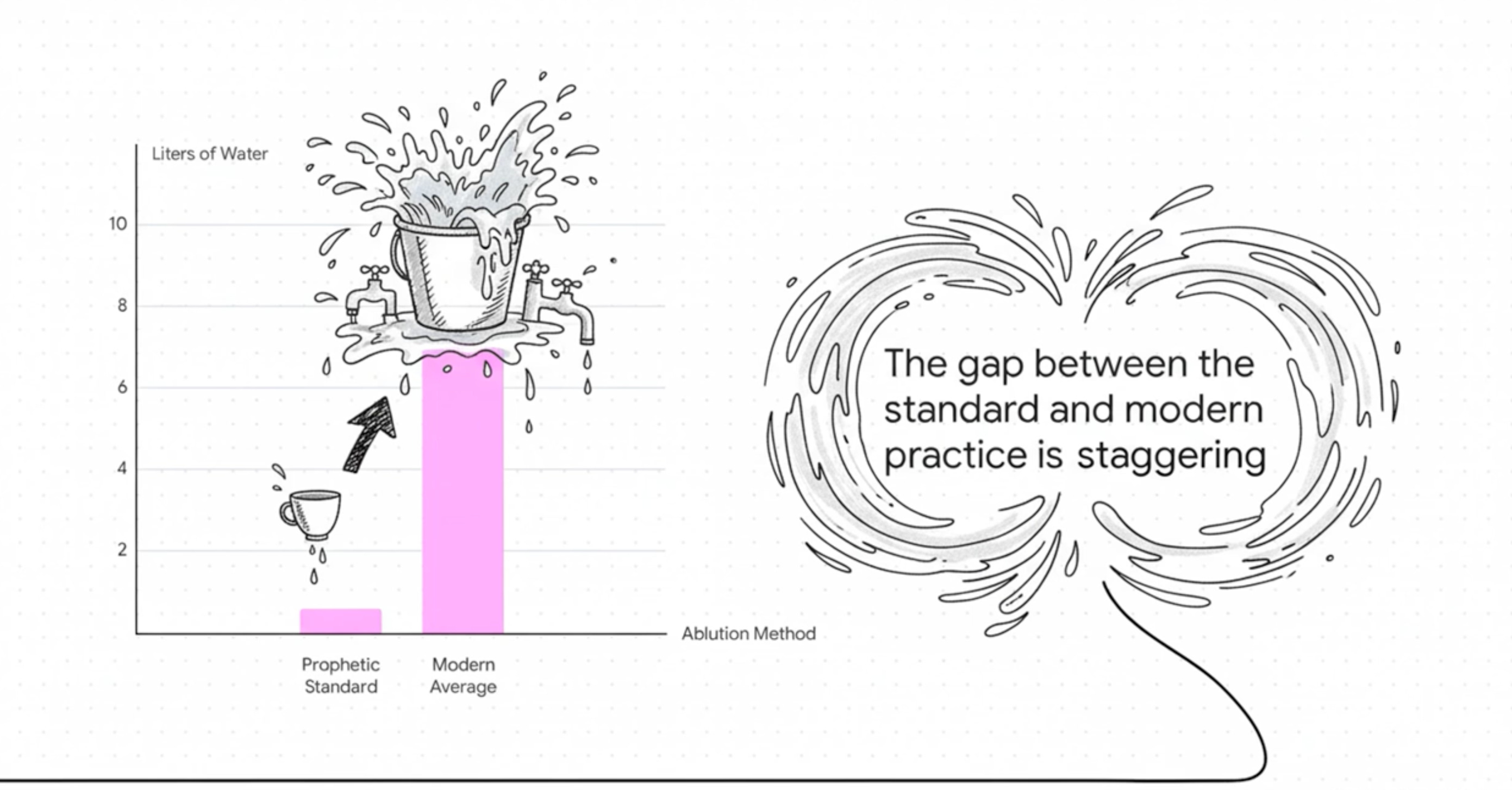
The mudd specification (0.6 liters) was never just a religious guideline. It was a systems design principle built for scarcity, one that fourteen centuries later still works precisely because it was designed for the constraint, not despite it.
But I did not arrive at that understanding through the faith alone. I came to it through two education systems that should have been connected from the start: the scientific training that taught me to measure water rigorously, and the lived reality of a country where water scarcity is not an abstraction but a daily calculation for millions of women I never had to see growing up.
What privilege and science taught me that I had to learn differently
I grew up in Mexico, in a middle-upper class family. Water came from the tap. I did not carry it. I did not wait for it. I did not pay for it with hours of my day.
But I knew that was not the reality of my country.
In Mexico, 57% of the population lack access to safe water by WHO standards. Much of the work required to secure and manage water in Mexico is carried by women, often through unpaid and unseen labor. In Mexico City’s lower-income neighborhoods, women spend between one and four hours per week hauling water or managing intermittent supply. In some communities, researchers have documented more than two hours per day. Among the poorest households, more than 60% of the water burden falls on women.
I did not grow up carrying water. But the women who did were in my country, in my lifetime, doing it every day while I studied science and engineering.
When I chose to dedicate my PhD to water desalination, I was not responding to personal scarcity. I was responding to professional responsibility. A scientist who understands the system cannot pretend the system is neutral. Water scarcity in Mexico is not a weather problem, it is a design problem. And one that falls hardest on the bodies of women who had no say in the design.
That is why the mudd is not a historical curiosity, but a systems specification with human consequences.
The mudd matters beyond religion and beyond chemistry for exactly this reason. A design solution that makes water go further does not just solve a technical problem. It returns hours to the people who could not afford to waste them in the first place.
What the broken signal costs
In January 2026, the United Nations University declared that the world has entered an era of “Global Water Bankruptcy”. The report, led by hydrology researcher Kaveh Madani, was deliberate in its language. Not a crisis, which implies something temporary. Bankruptcy, a structural failure of the ledger, where spending has permanently outpaced income.
The 2026 World Water Day theme, “Where Water Flows, Equality Grows,” chose its framing because the data demands it. Women spend 250 million hours per day globally collecting water, more than three times the burden carried by men. Over a billion women lack safely managed drinking water. Girls are nearly twice as likely as boys to be tasked with fetching it. Water scarcity has never been gender-neutral.
Here is what most people do not realize about water scarcity in Saudi Arabia specifically. The water-energy nexus here is extreme: producing fresh water costs roughly 25 times more energy than in most Western countries, because almost all of it comes from desalination.
The kingdom consumes roughly 300,000 barrels of oil per day to run its desalination infrastructure. When the price signal at the tap does not reflect that reality, behavior follows the broken signal instead.
Arjun Gidwani traces this in his piece on hydrostrategic realities, what water costs to produce and what people actually pay for it are two completely different numbers. That gap is not an accident of policy. It is the signal the system sends every time someone turns on a tap.
My PhD is in water desalination at KAUST. I know the cost of a liter of water in this region not as a number on a bill but as a thermodynamic calculation. Every liter wasted here is energy. Carbon. A cost the planet absorbs invisibly while the person at the tap feels nothing.
Researchers at KAUST’s Information Science Lab quantified exactly what this costs in the context of wudu water conservation. Their Smart-Tap AI project found that Saudi Arabia wastes approximately 8.4 billion liters annually due to inefficient ablution practices. Their AI-powered faucet, designed to match the mudd specification, could save 3.32 billion liters per year in Saudi Arabia alone, representing $81.2 million in annual savings. A water-energy nexus argument with a dollar figure attached.
In Islamic ethics, this is called israf, the prohibition of waste that runs through the Quran as a consistent principle. The role of humanity as khalifah, steward of the Earth, appears explicitly in Quran 6:165, and 35:39. The faith named this problem, quantified it, and provided the measurement tool. The abandonment of the mudd was not theological. It was behavioral. And behavior follows the signals a system sends.
The same principle, a parking lot and a washing machine in your pocket
I co-founded WAYAKIT in 2020 with two simple engineering questions: how to wash clothes without using water? how do you wash a car in a desert without using water?
The instinct came from scientific training, from years studying desalination at KAUST, from understanding precisely what it costs in energy terms to produce every liter flowing from a Saudi tap. The constraint-driven innovation approach, using the minimum viable amount to achieve the purpose, was not a compromise position. It was the design standard.
WAYAKIT’s laundry spray has saved over 5 million liters of water since 2020. The waterless car wash service at KAUST has saved an additional liters and counting. No sacrifice. No asking anyone to give anything up. A product that does the job with less, by design.
The Green Techpreneur has been documenting how Latin American climate founders are building constraint-first companies and the pattern is consistent: the founders who grew up with less built the more efficient systems.
The mudd and the spray bottle are the same idea, separated by fourteen centuries, a portable washing machine and a parking lot.
The question nobody asks at the river
Professor Jameel’s presentation included a Hadith I have not stopped thinking about since.
The Prophet passed by Sa’d while Sa’d was performing his purification ritual. The Prophet said: “What is this extravagance?” Sa’d replied: “Can there be any extravagance in ablution?” The Prophet said: “Yes, even if you are on the bank of a flowing river.”
Abundance does not change the setpoint. The system has a correct value regardless of how much supply surrounds you. Waste remains waste whether you are in a desert or standing in a river. The resource is not the point. The design is.
For many women in places like Oaxaca in Mexico, where getting water can take hours each day, “enough” is not an abstract idea. It is arithmetic.
The mudd was never only a religious detail. It was a practical limit designed for people who live with constraint.
And yet I found that limit in Madinah as a souvenir: a “Prophetic Mudd” displayed between prayer beads, its original function reduced to decoration.
The Mudd Test
I believe a good field observation changes something in your own operation. Here is the tool I want to leave you with.
Pick one resource your work runs on. Water, time, meeting hours, packaging, energy, or money. Ask three questions.
How much are we actually using per unit of output?
What is the minimum amount that achieves the same purpose?
What is the gap between those two numbers costing us annually?
A founder I know calculated that her team was spending 6 hours per week in alignment meetings. The minimum to actually stay aligned turned out to be 45 minutes. The gap was costing her roughly 250 hours of productive work per quarter, invisible because nobody had ever named it as a resource with a setpoint.
A supply chain operator discovered his company was using 340 grams of packaging per unit shipped. The minimum that protected the product without returns was 190 grams. The gap was costing him $180,000 annually in materials alone, on top of the environmental cost he had stopped calculating because the budget absorbed it without complaint.
Neither of them had a water problem. Both of them had a mudd problem.
That gap is the hidden inefficiency. Invisible because the price signal never made you feel it, and because nobody gave it a name before now. The mudd named it 1,400 years ago. The number was 0.6 liters.
What is yours?
The women carrying water in Mexico’s lower-income neighborhoods could answer without hesitation. They know the minimum because they live with the constraint. The question for the rest of us is whether we design our systems with that precision before water scarcity forces the calculation on us, or after.
What comes next
This is Field Observation 004 in the Sustainable Systems Lab’s World Water Day 2026 series.
The next piece looks at the planetary cost of this broken setpoint at scale. What happens when you multiply 0.6 liters by 1.8 billion people, five times a day, 365 days a year, in regions where every liter costs 25 times more energy to produce, and where the UN has already declared us officially bankrupt. The numbers are not comfortable. They do point toward something actionable.
If the Mudd Test surfaces something real in your operation, leave it in the comments. I read every one.
Subscribe to Aziul Connections (The Sustainable Systems Lab)
Public lab studying sustainable systems across business, leadership, and life. Essays, experiments, field observations and case studies from a climate-tech founder (Dr. Luisa Javier) operating between LATAM and MENA. Aziul = Azul (the planet) + Luisa (backwards)
About the author - Dr. Luisa Javier
Dr. Luisa Javier is a scientist and climate-tech entrepreneur across LATAM & MENA, focused on designing sustainable systems for business and society. She is the Founder and CEO of WAYAKIT Group and the author of **Aziul Connections.**
Aziul Connections is the public lab where I study how sustainable systems are built.
“I build sustainable living through WAYAKIT, and study the systems behind it through Aziul Connections.”
Thank you for reading or listening to this article, and if this sparked a “Mudd Test” in your own life or work, share this article.
Luisa
Connect with me
LinkedIn: https://www.linkedin.com/in/luisajavier/
Instagram: https://www.instagram.com/luisa.emi
Snapchat: https://www.snapchat.com/@luisaemijavier