

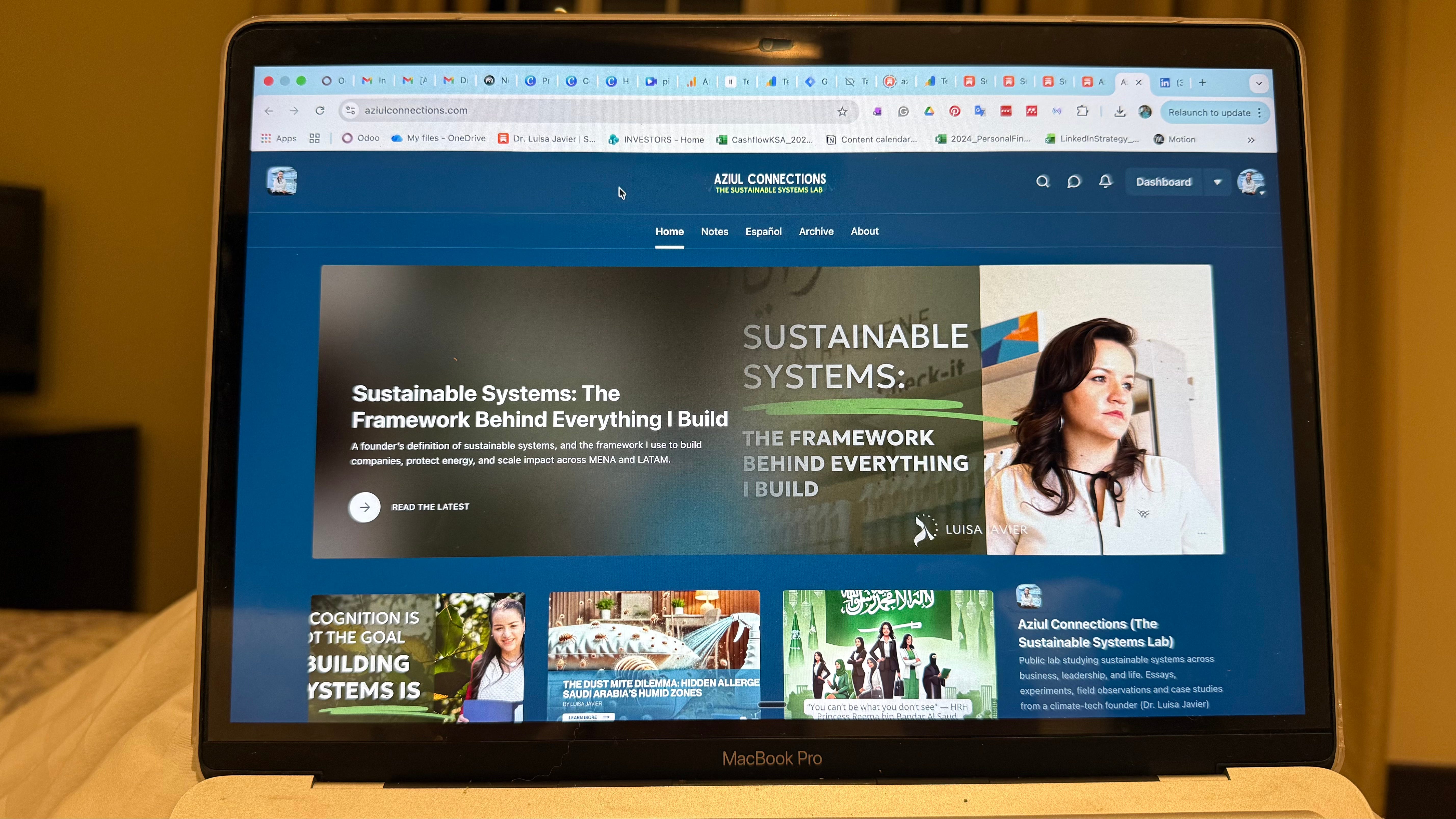
We live in a moment where the word sustainability appears in almost every conversation.
And yet most people building something real, a company, a team, a life with actual impact, are still figuring it out alone.
Not because the information does not exist.
Because the systems that should carry them are not well designed.
The Sustainable Systems Lab is a public research space built around one question:
How are systems designed to be economically, environmentally, and humanly sustainable?
Not in theory. In practice. In the middle of a difficult week, an impossible decision, a mission that is larger than your current capacity to hold it.
This laboratory exists because sustainability is rarely a technology problem.
It is a system design problem.
And system design problems are solvable.
What brought me here
My scientific training taught me something that took years to fully understand: complex problems are not solved with isolated solutions. They are solved by understanding the systems that generate them.
I spent years applying that logic to water, to biotechnology, to building WAYAKIT Group across Saudi Arabia and Latin America.
Then I started applying it to everything else.
To how a founder stays alive inside when the company is demanding everything outside. To how a leader shows up as the mirror their team deserves when their own framework has just collapsed. To how a person keeps moving when the structure that made sense of their life has been taken from them.
I have done all of that. Not as a thought experiment. As my actual life.
What I found, each time, was this: the people who kept going were not tougher or more talented.
They had better systems. Personal systems. Operational systems. Inner systems that held even when everything external was falling apart.
That is what this laboratory documents.
How the laboratory works
The Sustainable Systems Lab studies systems through four types of research:
1️⃣ Foundational Papers
Conceptual frameworks and theoretical foundations that establish definitions, principles, and structures to understand how sustainable systems work.
These essays synthesize knowledge from science, business, and practical experience.
Key question: What do we know about how sustainable systems are designed?
2️⃣ Experiments
Tests of systems in real life — in business, leadership, motherhood, crisis, and productivity.
These are my personal experiments: what works, what fails, and what I learn in the process.
Key question: What happens when we put these systems to the test in practice?
3️⃣ Field Observations
Study of systems operating in the real world — in cities, governments, companies, infrastructure, and institutions.
Here I observe how sustainable systems function at scale.
Key question: How do sustainable systems operate in real contexts?
4️⃣ Case Studies
Analysis of how different leaders — founders, scientists, operators, policymakers — design systems that endure.
Each conversation extracts systems of decision-making, leadership, operation, and resilience.
Key question: How do people who build durable organizations design systems?
Systems I study
The laboratory explores sustainable systems across multiple domains:
Sustainable Systems — general sustainability frameworks
TAPPPP Framework — the six-dimension filter for evaluating sustainability
Business Systems — how scalable organizations are designed
Leadership Systems — decision structures and resilience
Personal Systems — energy, attention, and purpose
Innovation Systems — how new ideas are designed and scaled
Operational Systems — structures that sustain daily execution
Emerging Market Systems — operating between LATAM and MENA
Hygiene Systems — innovation in sustainable cleaning
Aviation Systems — sustainability in aeronautical operations
Facilities Systems — infrastructure management
Water Stewardship Systems — conservation and water technology
Women Systems — female leadership and system building
Three dimensions of sustainable systems
The laboratory observes systems from three interconnected dimensions, because a system that only works in one of them is not sustainable.
Systems in business
How companies, business models, and organizations generate economic value without destroying the conditions that make that value possible. This includes incentive design, operational structure, and the honest accounting of what a business actually costs.
Systems in innovation
How science, technology, and entrepreneurship integrate to create solutions that survive contact with the real world. Most innovations fail not because the idea is wrong but because the system around the idea is fragile.
Systems in life
How people, leaders, and communities sustain energy, purpose, and connection over time. This is the dimension most people skip. It is also the one that determines whether any of the other systems hold.
The world will always be chaotic. The question is whether you have a system that carries you through it.
What you will find here
Each article in this publication is a note from the laboratory. An honest attempt to understand how systems are built to endure, and what that means for the people building them.
You will find essays that connect scientific thinking with founder experience. Field observations from operating between Saudi Arabia and Mexico. Experiments run on real conditions, not optimal ones. And case studies from people who built something real and were willing to be honest about how.
The writing does not perform confidence it has not earned. It does not generalize what has not been proven. And it does not pretend that building something sustainable is simple.
It is not simple. But it is learnable. And you are not alone in learning it.
An invitation
If you are building something that matters, and you are doing it while managing more than most people around you understand, this space is for you.
Not because it has all the answers. Because it is asking the same questions you are, out loud, with evidence, and with the honesty that only comes from having the system actually fail first.
Subscribe to the experiment in the Sustainable Systems Lab. You are not alone in the zombie state.
→ Start here: Sustainable Systems: The Framework Behind Everything I Build
About the author
Dr. Luisa Javier is a scientist and entrepreneur focused on designing sustainable systems for business and society. She is the Founder and CEO of WAYAKIT Group and the author of Aziul Connections, a publication dedicated to exploring sustainability, entrepreneurship, and systems thinking.