


Highlights
In the GCC, your tap water feels free. It costs 25x more energy to run than water almost anywhere else on Earth.
The UN just declared water bankruptcy. Not a crisis. Something worse.
300,000 barrels of oil burned daily: just to make Saudi Arabia’s drinking water.
30 billion liters of wudu water flow every day. Most of the world doesn’t see the cost.
You don’t need guilt. You need the right lenses. Here they are.
👋 Hi, it’s Luisa Javier. Welcome to Aziul Connections ( 🌎🔬The Sustainable Systems Lab), where I study how sustainable systems are built for business, leadership, and life.
🎧 Listen to Luisa read this article
Every morning I open the tap in my kitchen in KAUST.
The water comes out clear, instant, unremarkable. My son fills his glass. I start the coffee. The day begins. You probably do the same thing, wherever you are. The tap opens. The water runs. The day takes over.
What neither of us sees is the machine behind it.
The ritual you already know. Here is the cost behind it.
In the last article in this series, I measured the wudu, or the cleaning ritual Muslims do before prayer. The prophetic mudd — 0.6 liters — the amount the Prophet Muhammad, peace be upon him, used for ritual purification. I asked what would happen if we applied that standard to a region where water does not exist in nature. Where every drop that comes out of your tap was once salt water pulled from the Red Sea or the Arabian Gulf, forced through membranes under enormous pressure, and delivered to your home through infrastructure that consumes a significant portion of this country’s daily energy production.
That article quantified the ritual. This one quantifies the cost.
There are 1.8 billion Muslims in the world, and most perform wudu at least three times a day. At the prophetic minimum of 0.6 liters per ablution, that is over 3 billion liters of water used for wudu alone, every single day. But in the previous article we found that most people use, on average, 10x more water, meaning 30 billion liters of water!
This is the equivalent amount of water of 12,000 olympic swimming pools of water every single day! To be honest, I don’t want to go over the annual calculation.
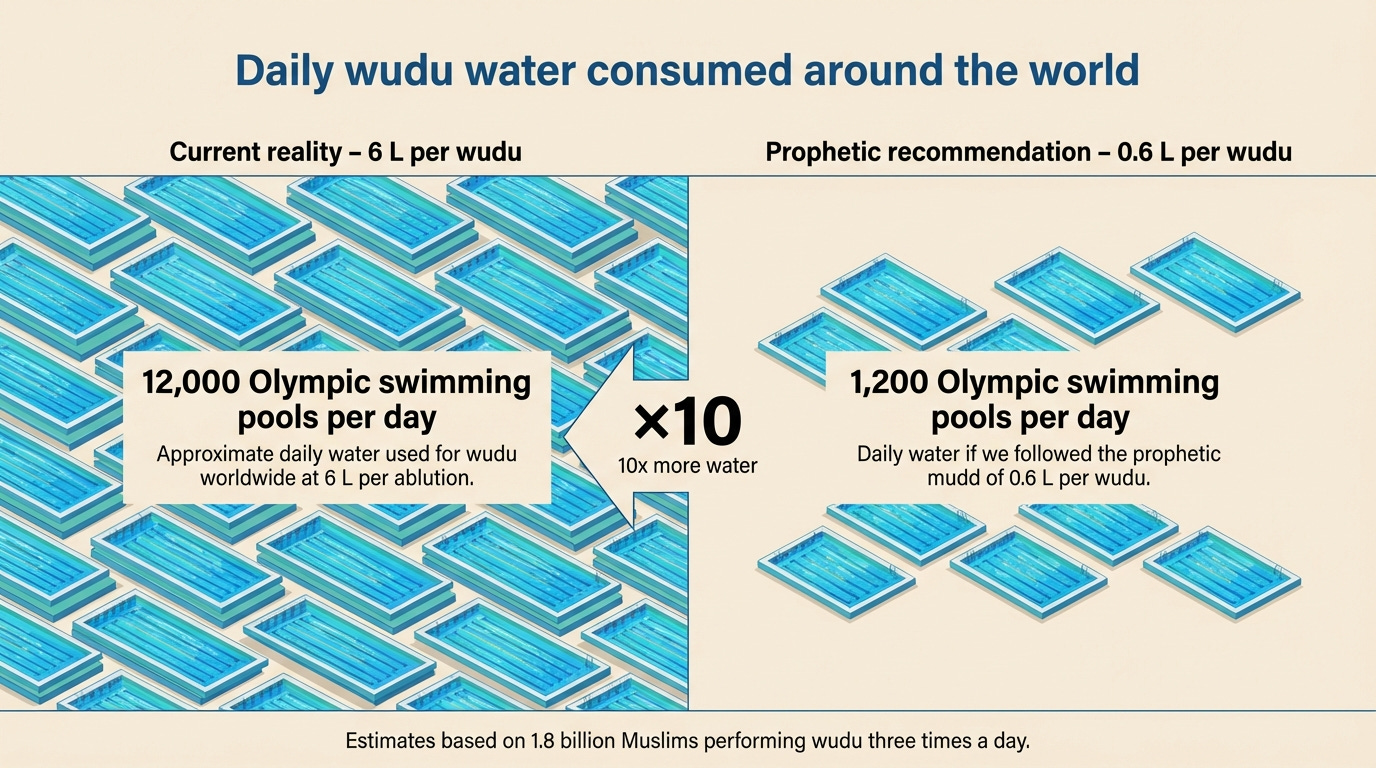
Most of that water in different parts of the world comes from rivers, reservoirs, and groundwater. It falls from the sky. It costs almost nothing to produce.
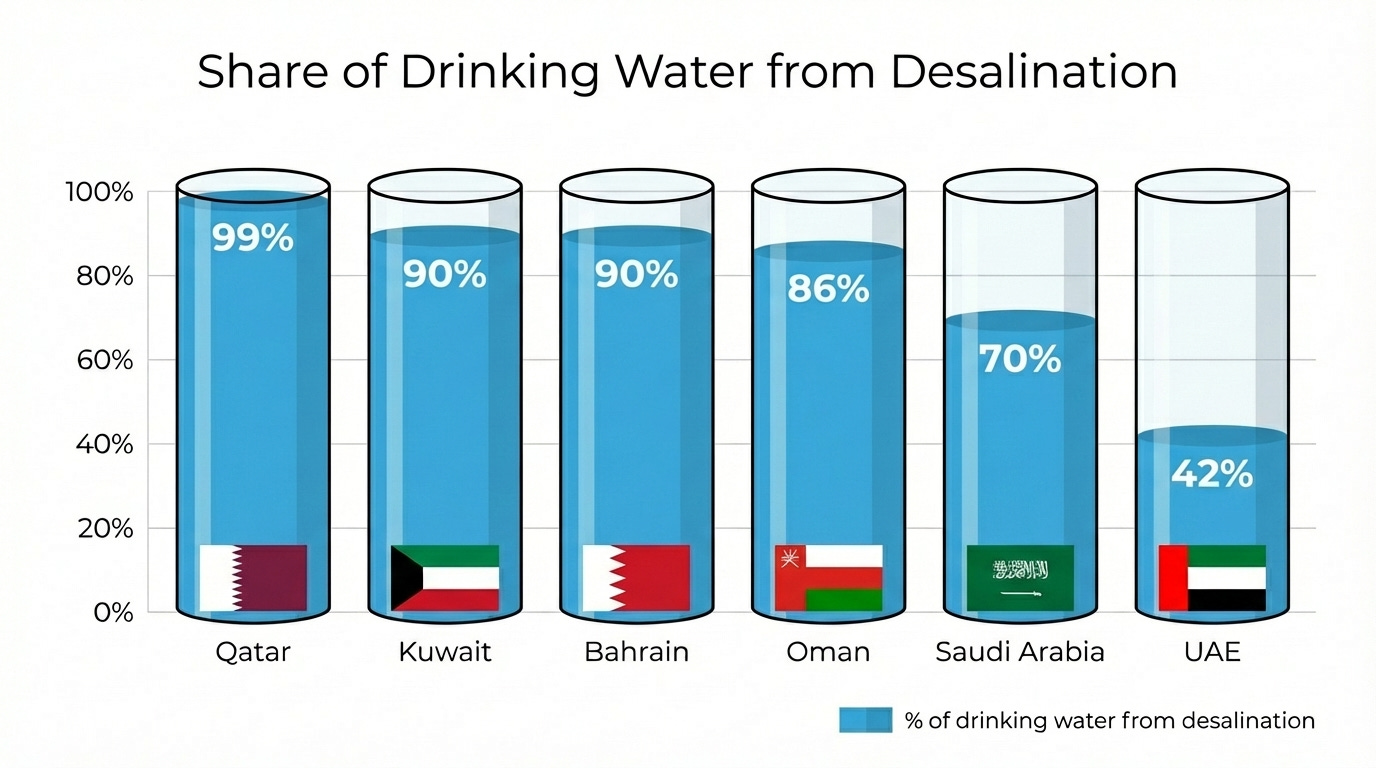
Here in the Gulf, it does not fall from the sky. 83% of the population of the Middle East and North Africa already lives under severe water scarcity. The Middle East operates 41.8% of the world’s entire desalination capacity. Qatar gets 99% of its drinking water from desalination. Kuwait and Bahrain, 90%. Oman, 86%. Saudi Arabia, 70% and UAE, 42%.
The world is no longer in a water crisis. It is in water bankruptcy.
In January 2026, the United Nations made something official that scientists had been building toward for years: global water bankruptcy.
The language matters. A crisis implies recovery. Bankruptcy implies irreversibility — systems that have been overdrawn past the point of return. Kaveh Madani, Director of the UN University Institute for Water, Environment and Health, put it plainly: for much of the world, normal is gone. Andrew Curry, writing in Just Two Things, captured the distinction precisely: the checking account is empty, and the savings account is being drained.
“For much of the world, normal is gone.” — Kaveh Madani, Director, UN University Institute for Water, Environment and Health
What does that mean for someone living in a place where normal never included fresh water to begin with?
It means the invisible cost was always there. We just never had a word for what happens when the bill finally comes due.
The number that changes how you see every tap
Here is the number I want you to remember. I worked it out during my Ph.D. in water desalination.
Producing one cubic meter of drinking water through seawater desalination in the Middle East requires approximately 5 kilowatt-hours of energy for a full plant at Gulf salinity levels. Treating the same cubic meter from a conventional surface water source requires roughly 0.2 kilowatt-hours.
That is a ratio of 25 times more energy. Per cubic meter. Every day. For every person in this region whose water arrives with no alternative.
Saudi Arabia consumes around 300,000 barrels of oil daily just to run its desalination plants — approximately 20 percent of the country’s total oil production. Not to power cities or factories. To manufacture the water that comes out of your tap.
When you open that tap, you are not turning on water. You are turning on an industrial process with no equivalent anywhere else on the planet.
Why your brain tells you water is free — and why that is the problem
I call this the lens problem.
The water looks the same. It feels the same. It costs almost nothing on your monthly bill, because governments here heavily subsidize the real price of production. So your brain registers it as free. Or close to it.
But the scientist in me cannot unsee what is behind it.
I have a thought experiment I shared recently that I cannot stop thinking about: what if, instead of water coming out of that tap, you could see what actually produced it? Not liters. Energy units. The barrel fractions. The infrastructure cost of manufacturing something that falls freely from the sky almost everywhere else in the world. Twenty-five times the energy of water that simply exists. Made invisible by a subsidized bill and a tap that always works.
“Most people who waste water are not careless. They are simply not wearing the right lenses.”
The one thing you can do before the water runs
So here is what I am asking.
The next time you open a tap — whether you are here in the Gulf, in Mexico City where the aquifer beneath the streets is collapsing at 25 centimeters per year, or anywhere else on this planet that the UN has now formally declared water bankrupt — take three seconds before the water runs.
Think about what it cost to get there.
Clarity, not guilt. Seeing, not alarm.
The world will not solve water bankruptcy through fear. It will solve it through people who finally see what the system has been hiding in plain sight. The invisible cost of water is only invisible because no one has handed you the lenses yet.
Now with this article, you have them.
Subscribe to Aziul Connections (The Sustainable Systems Lab)
Public lab studying sustainable systems across business, leadership, and life. Essays, experiments, field observations and case studies from a climate-tech founder (Dr. Luisa Javier) operating between LATAM and MENA. Aziul = Azul (the planet) + Luisa (backwards)
About the author - Dr. Luisa Javier
Dr. Luisa Javier is a scientist and climate-tech entrepreneur across LATAM & MENA, focused on designing sustainable systems for business and society. She is the Founder and CEO of WAYAKIT Group and the author of **Aziul Connections.**
Aziul Connections is the public lab where I study how sustainable systems are built.
“I build sustainable living through WAYAKIT, and study the systems behind it through Aziul Connections.”
Thank you for reading or listening to this article, share it or leave a comment if you find this information useful!
Luisa
Connect with me
LinkedIn · Instagram · Facebook · Snapchat · TikTok
This is the second article in the World Water Day series at Aziul Connections. The first, Field Observation 004: The 0.6 Liter Water Rule, introduced the Mudd Test as a framework for measuring water use against its real constraints.
Sources:
*Center for Strategic and International Studies (2026). “Could Iran Disrupt the Gulf Countries’ Desalinated Water Supplies?” CSIS.*
*IEA (2026), “Wired for water: How electrification is transforming desalination”*
*Just Two Things by Andrew Curry, “4 February 2026: Water | AI”*
*Madani, K. (2026), Global Water Bankruptcy: Living Beyond Our Hydrological Means in the Post-Crisis Era, United Nations University Institute for Water, Environment and Health. DOI: 10.53328/INR26KAM001*
*Park et al. (2020), “A comprehensive review of energy consumption of seawater reverse osmosis desalination plants,” Applied Energy 254, 113652. DOI: 10.1016/j.apenergy.2019.113652*
*Plappally and Lienhard (2012), “Energy requirements for water production, treatment, end use, reclamation, and disposal,” Renewable and Sustainable Energy Reviews 16(7), 4818–4848. DOI: 10.1016/j.rser.2012.05.022*
Excelent point of view