


Highlights
Catalina arrived in Riyadh with the professional pitch she had built in Bogota. Fifteen seconds in, she discovered it no longer worked
Before Saudi Arabia, she had already lost another building: a nine-year creative agency built with her ex-husband
The phrase that stayed with her from that loss: “I started building an empire on someone else’s foundation”
The response was not to start over. It was to design a system: internationalization of the self, five layers that begin with the being
Today she teaches that system. This conversation is what I learned when I gave her back the question she asked me three years ago
👋 Hi, it’s Luisa Javier. Welcome to Aziul Connections ( 🌎🔬The Sustainable Systems Lab), where I study how sustainable systems are built for business, leadership, and life.

🎧 Listen to the full interview with Catalina González Calle
Catalina is the first woman I interview for this series. The three previous conversations were with men building startups: Esteban Canepa, Hassan Bash and Rodrigo Jiménez Sandoval. That case four is with a woman, and that the woman is Catalina, is not accidental. Three years ago, in a difficult moment of WAYAKIT, she was my coach. Aziul Connections began to take shape in those sessions, when she saw something in me that I could not yet see. This case study was born there.
Let me start with the scene she told me when I asked what happened the first time, she introduced herself professionally in Riyadh.
Who am I when the titles are taken away
Catalina arrived at a networking event with her usual pitch. Nice to meet you, I am proudly Colombian, my name is Catalina, I work in strategy. The person on the other side asked her two questions she had never heard before.
And where is Colombia? What does your name mean?
Fifteen seconds. That is how long a professional introduction lasts. And in fifteen seconds Catalina realized hers was built from supports that did not exist in that room. The contact network, the recognition of her name, the shared context of fifteen years working strategy for Latin American companies — none of those pieces traveled with her to Riyadh.
Underneath the house of cards that collapsed that night sat a question she had never asked herself.
Who am I when the titles are taken away.
This is not the question of someone who lost a job. It is the question of someone who understands, all at once, that her professional identity was held up by a building that was no longer there.
What is lost when you build on someone else’s foundation
The scene in Riyadh was not the first time Catalina lost a building. Before Saudi Arabia, in Bogota, she had already lost a much bigger one.
She told me that for nine years she built a creative agency with her then husband. When the relationship ended, the company did too. They did not close it. It kept his last name. Catalina gave it up for her peace. And in giving up the building, she lost the professional name she had built inside it.
I started building an empire on someone else’s foundation.
That sentence is not only about divorce. It is about any woman who built her career inside a borrowed identity. The company where you were the visible face, but the owner had a different name. The cofounder’s project where you carried operations. Someone else’s personal brand inside which your work was invisible.
The loss of professional identity in migration is a documented phenomenon in clinical psychology. What Catalina did differently was stop treating it as grief and start treating it as a design problem.
The system that answered the loss
What Catalina built afterward she calls something I had not heard in any coaching manual: internationalization of the self. It is not a metaphor. It is a five-layer system that begins with the being and ends with sustainable expansion.
Being. Dreaming. Doing in balance. Remaining. Transcending.
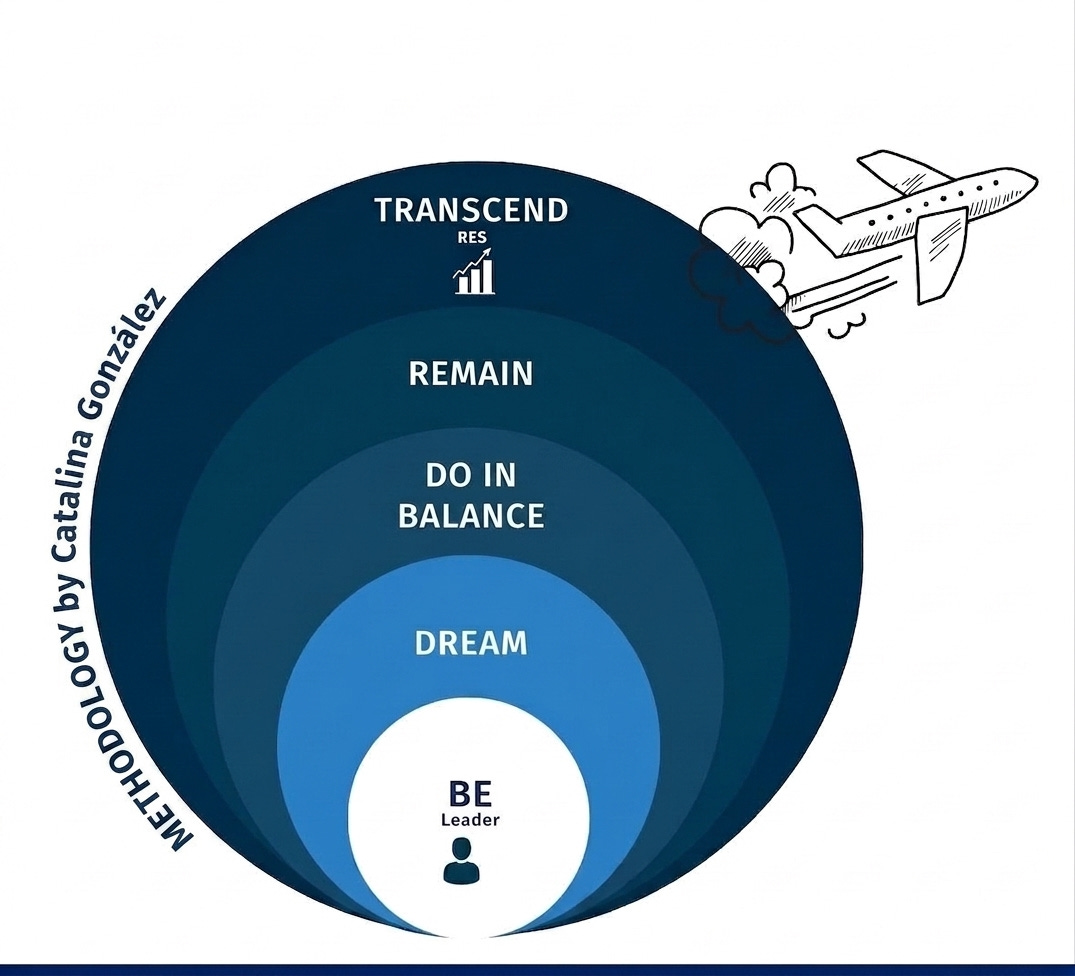
That is the order. It is not accidental.
When I asked her to explain the logic, she said:
Having clarity about our roots, our values, our history, where we come from. That is unique. Irreplaceable.
The system inverts the logic with which most women founders build their brand. Being before doing. Roots before expansion. And most counterintuitive of all: transcending is not the goal of the system; it is the consequence of the four previous layers well designed.
What Catalina understood when she lost the building in Bogota and understood again when they asked about Colombia in Riyadh, is that no external system holds if the human being carrying it is not designed first.
It is the same idea that holds up this lab, said by a different woman, in a different language, after a different kind of collapse.
The question that changed my life, and I gave it back to her three years later
Three years ago, Catalina asked me a question that changed me.
Why aren’t you building your personal brand?
I was inside WAYAKIT, fused with my own company, not understanding that my personal brand was a different system from the company I ran. Catalina named it before I could see it.
In this interview I gave her the question back.
I am the one who asks the questions.
That was her first reaction. Pause. Short laugh. Resistance. And then, the answer of the woman, not the coach: that she is building, for the first time in her life, her own personal brand. That she had always built brands for others and never for herself. That she is enjoying it, and that she still cannot believe she is doing it.
Three questions you can ask yourself tomorrow
You do not need to be in Riyadh to ask yourself these three. A notebook is enough.
Who am I when the titles are taken away?
What questions would I rather not be asked, and which ones do I already have structured?
What network, what recognition, what reference holds up my professional identity today, and what would happen if I lost it tomorrow?
The answer does not arrive fast. Sometimes it does not arrive in a week. But the question opens something that does not close on its own. And as Catalina said closing the conversation:
When we think about expanding, let us start from ourselves.
What else we covered in the interview
This conversation opened three themes that do not fit in a quick note and that I will develop separately:
Latin America and the Gulf as opposite and complementary systems. How the scarcity of the desert built a different abundance from ours, and what each side has to learn from the other
Latin femininity and Arab femininity as two models of power. Different codes, different results, crossed lessons
The two profiles of coach the sophisticated client looks for: the grounded one and the ethereal one. Why one without the other is no longer enough at this moment of the market
Follow Catalina
Catalina González Calle writes at Catalina entre dos mundos, her Substack between Bogotá and Riyadh. You can also find her on LinkedIn and Instagram as @catalinaconsultant.
The full interview is available on video. There Catalina explains the five layers of the system with the detail this note cannot reach and opens the three themes we left for later.
For further reading
Fundación Clínica de la Familia (2026), “Migrar y perder referencias: identidad, trabajo y nostalgia en la experiencia migrante,” clinical blog, Madrid.
Subscribe to Aziul Connections (The Sustainable Systems Lab)
Public lab studying sustainable systems across business, leadership, and life. Essays, experiments, field observations and case studies from a climate-tech founder (Dr. Luisa Javier) operating between LATAM and MENA. Aziul = Azul (the planet) + Luisa (backwards)
About the author - Dr. Luisa Javier
Dr. Luisa Javier is a scientist and climate-tech entrepreneur across LATAM & MENA, focused on designing sustainable systems for business and society. She is the Founder and CEO of WAYAKIT Group and the author of Aziul Connections.
Aziul Connections is the public lab where I study how sustainable systems are built.
“I build sustainable living through WAYAKIT, and study the systems behind it through Aziul Connections.”
Thank you for reading or listening to this article, share it or leave a comment if you find this information useful!
Luisa