


Highlights
Most founders report mental health challenges.
Esteban Canepa, founder of Sadeem Technology, articulated two systems that operate on different layers.
Purpose pushes you in the long term, but it does not sustain you on the days when purpose is not enough.
Life is a jazz concert. Ritual is the structure. Bad days are the bars where you improvise.
Building a company between Latin America and the Middle East requires a level of resilience few people understand.
👋 Hi, it’s Luisa Javier. Welcome to Aziul Connections ( 🌎🔬The Sustainable Systems Lab), where I study how sustainable systems are built for business, leadership, and life.
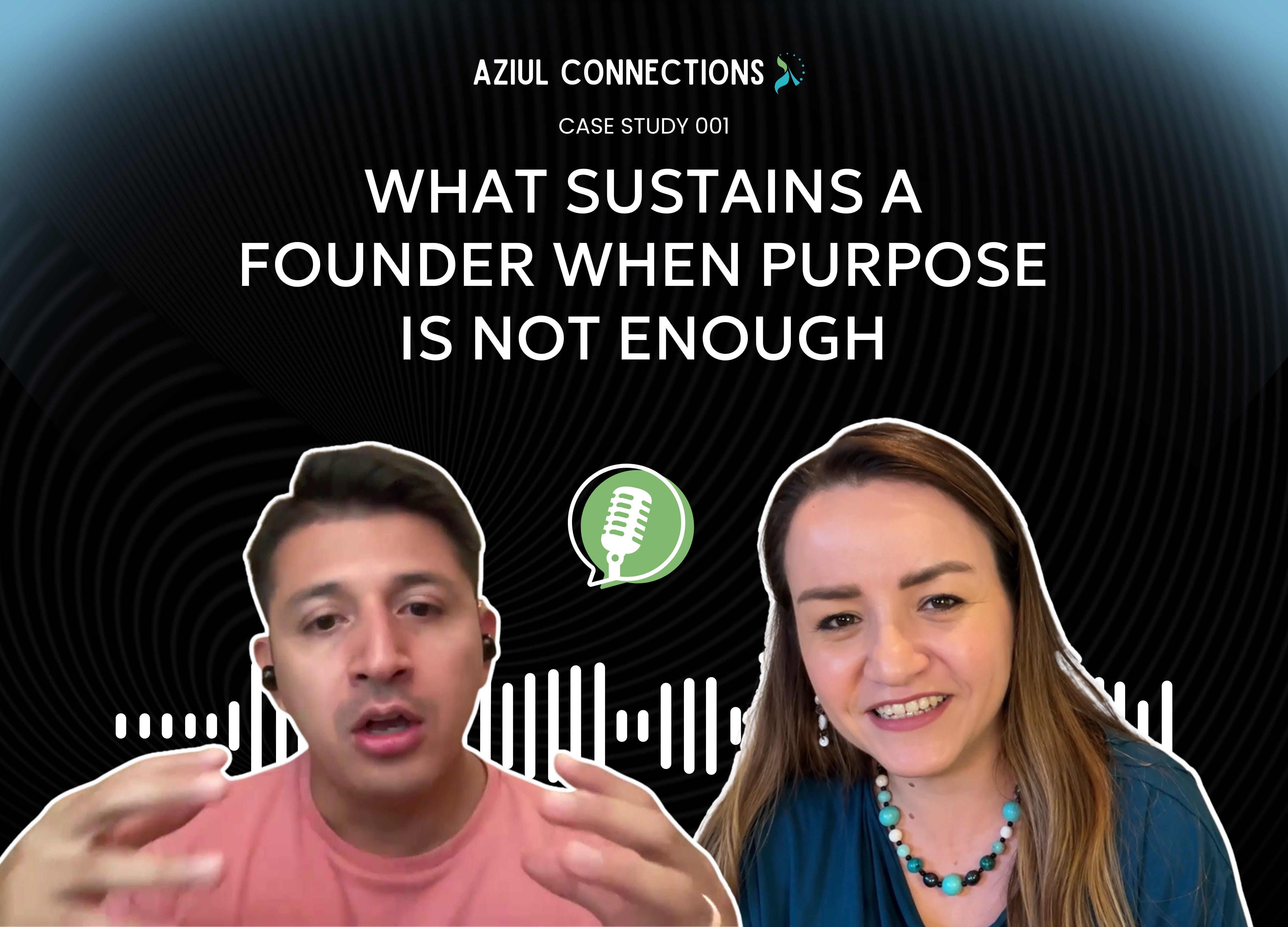
🎧 Listen the full interview in Spanish here
Why Esteban is the first case study
A few weeks ago, I interviewed Esteban Canepa, founder of Sadeem Technology, a flood prevention sensor company operating from Saudi Arabia across four countries.
I chose him as the first case study for Aziul Conexiones for a specific reason. We both arrived at KAUST in the same year, 2009. Together, we did something that, at the time, almost no one could even locate on a map: we built an intersection between Latin America and the Middle East. We chose to build in a country very few people in our region could understand.
Seventeen years later, we are both still here. Still building.
And that is what I wanted to study first: what life systems sustain a founder when the path looks nothing like anything you have ever seen before.
At one point in the conversation, Esteban paused and asked himself a question:
What do you do if you have several bad days in a row?
At that moment, I did not yet know that in a study published in Small Business Economics, 72% of founders report experiencing mental health challenges.
Esteban did not say that statistic. But the answer he gave explains why he is still standing ten years after founding Sadeem.
The system for good days is not the problem
Most founders are clear on their purpose. They know why they started. They have a long term drive that pushes them through the marathon.
The problem is that drive is designed to finish the marathon. Not to carry you through the kilometers where your body collapses.
Esteban said it like this, without me even asking:
I would describe it as a long term system, your drives. That is what pushes you to finish that 40 kilometer marathon. But on the other hand, you have your daily mitigation system, a smaller system.
Two systems. Not one. That distinction stopped me.
The first system is the why. The deep reason. What makes you a founder for life, as he put it.
The second system is something else entirely: a small ritual repeated every day, regardless of how you feel.
The drive pushes you through the marathon. The ritual sustains you in the kilometers where your body collapses.
Most founders I know only have the first one.
What Esteban does at 6 in the morning
I asked him what his mitigation ritual was. I expected something elaborate.
He said: I wake up early and I exercise.
That was it.
But then he added the line that changed how I think about morning routines:
It helps me feel empowered on the days I exercise.
Empowered. Not motivated. Not optimized. Empowered to face the day.
In my own experimentation, documented in this lab, I have seen the same thing. The continuity of a ritual is not discipline. It is architecture.
A morning routine does not exist for the days you feel like it. It exists for the days you do not feel like it and still show up.
The ritual is not for the good days. The ritual exists to give continuity to the mission on the bad days.
That is its function. To mitigate.
To prevent one bad day from becoming three.
Three from becoming a week.
A week from costing you your company.
Life as a jazz concert
Toward the end of the interview, I asked him a question I ask every founder who comes through here: if you could pass on one life system to the next generation, what would it be?
Esteban answered:
I think life is lived like a jazz concert. Songs have a structure, but the musician can improvise if they feel it. But that musician always returns to the structure.
Structure with improvisation.
The ritual is the structure. The bad days are the bars where you improvise. But you always return.

The reason most founders never build the second system is that admitting bad days will come feels like admitting the external system is not always enough. And in an industry that rewards the appearance of control, that is uncomfortable.
But jazz gives us the answer. The structure is not there to prevent bad days. It is there so you have somewhere to return to afterward.
What else we covered in the interview
The conversation with Esteban covered much more than what fits in this article. If you listen to the full version, you will find:
The real distance between publishing a scientific paper and having your technology running in the field at 3 in the morning.
Why he shifted from academia to entrepreneurship in a single week in 2016.
What he assumed for years in the lab that reality later proved wrong.
How he has sold technology in Middle Eastern and Latin American markets, and what fundamentally changes between them.
And why he decided to found Fundación Amal alongside his company.
The full audio is above.
What you can do tomorrow
Three questions, directly from the conversation with Esteban:
First: what is your long term drive? Most people can answer this. If you cannot yet, that is another article, another layer.
Second: what is your daily mitigation ritual? This is where most people go quiet. If your answer is “I do not have one,” you already have your first data point.
Third: what would happen if your ritual disappeared for three days? This one tells you the most. If the answer is “nothing, I will come back when I can,” you have a routine, not a system. If the answer is “everything else collapses,” then you have the architecture but not yet the system.
Esteban does not have a more sophisticated system than you. He has a smaller one. And a more consistent one.
That was the lesson.
What is your ritual for bad days? Share it in the comments. I want to see what other founders are building in their second system.
Next week, another founder. Another layer of the same system.
Subscribe to Aziul Connections (The Sustainable Systems Lab)
Public lab studying sustainable systems across business, leadership, and life. Essays, experiments, field observations and case studies from a climate-tech founder (Dr. Luisa Javier) operating between LATAM and MENA. Aziul = Azul (the planet) + Luisa (backwards)
About the author - Dr. Luisa Javier
Dr. Luisa Javier is a scientist and climate-tech entrepreneur across LATAM & MENA, focused on designing sustainable systems for business and society. She is the Founder and CEO of WAYAKIT Group and the author of Aziul Connections.
Aziul Connections is the public lab where I study how sustainable systems are built.
“I build sustainable living through WAYAKIT, and study the systems behind it through Aziul Connections.”
Thank you for reading or listening to this article, share it or leave a comment if you find this information useful!
Luisa
Connect with me
LinkedIn · Instagram · Facebook · Snapchat · TikTok
Follow Esteban and Sadeem
Esteban Canepa regularly shares insights on entrepreneurship, film, and life between Latin America and the Middle East.
Fundación Amal — a social initiative in Mexico focused on children, entrepreneurship, and education
For further reading:
*Freeman, M. A., Staudenmaier, P. J., Zisser, M. R., & Andresen, L. A. (2019). The prevalence and co-occurrence of psychiatric conditions among entrepreneurs and their families. Small Business Economics, 53(2), 323–342. DOI: 10.1007/s11187-018-0059-8*
*Hobson, N. M., Schroeder, J., Risen, J. L., Xygalatas, D., & Inzlicht, M. (2018). The psychology of rituals: An integrative review and process-based framework. Personality and Social Psychology Review, 22(3), 260–284. DOI: 10.1177/1088868317734944*
*Wood, W. (2017). Habit in personality and social psychology. Personality and Social Psychology Review, 21(4), 389–403. DOI: 10.1177/1088868317720362*
*Murnieks, C. Y., Arthurs, J. D., Cardon, M. S., Farah, N., Stornelli, J., & Haynie, J. M. (2020). Close your eyes or open your mind: Effects of sleep and mindfulness exercises on entrepreneurs’ exhaustion. Journal of Business Venturing, 35(2), 105918. DOI: 10.1016/j.jbusvent.2018.12.004*