


Key points
Polymeron turns Saudi date waste into pellets of biodegradable plastic. The original idea was to make plastics with fungi. It didn’t work.
Rodrigo chose not to capitalize Polymeron through venture capital when he started, and today he approaches investors from a different position.
His lowest moment was not technical or financial. It was a conflict with a cofounder during his PhD.
The first spoon made from date waste took eight years to come out. The system that made it possible was not in the lab.
When I asked him what system he would pass on to the next generation, Rodrigo answered in three words: a system of people.
👋 Hi, it’s Luisa Javier. Welcome to Aziul Connections (🌎🔬 The Sustainable Systems Lab), where I study how sustainable systems are built for business, leadership, and life.
🎧 Listen to the full interview with Rodrigo Jiménez
Lee el caso de estudio en Español
Why Rodrigo is case study 003
Rodrigo Jiménez Sandoval is a biologist from UNAM in Mexico City. He arrived at KAUST in 2012 for a master’s in environmental science and engineering, returned to Mexico for four years, and came back in 2018 for the PhD. That second time around, he started Polymeron, the company he cofounded with Martín Ibarra to convert Saudi date waste into pellets of biodegradable plastic.
In 2019 the world produced 460 million tonnes of plastic, and only 6% came from recycled sources.
Polymeron is not the solution. It is a case study of how a small piece of the solution gets built over eight years without collapsing.
It started as a side project in my life
“As an idea, Polymeron came up at the end of 2018. It started as a side project in my life, and then we started winning competitions. There was a moment when I was completely wrapped up in the company.”
The first version of Polymeron was not date-based. It was fungal. Rodrigo and his team iterated, saw that it would not scale, and pivoted to date waste. Saudi Arabia is the world’s second largest date producer. The raw material was literally on the street.
What stands out is not the pivot. It is the pace. A full decade between the original idea and the first pellets sold. Most founders building deep tech collapse in year three because the initial round runs out before the science is ready.
If we had started with venture capital, we would have no room to attract investors today
This decision is the backbone of the Polymeron system.
“If we had capitalized through venture capital from the start, we would not have much room to attract investors at this stage.”
The capital sequence was specific and deliberate. First, the KAUST TAQADAM accelerator, which covered the company registration and the first products. Then an international competition by Tanmiah, Saudi Arabia’s second largest poultry producer, which spent ten million riyals a year disposing of chicken waste and wanted to monetize it instead. Polymeron won. Tanmiah became a business partner. After that came funding from the National Technology Development Program. Three non-dilutive sources. Zero equity given up.
Only now, with a finished product and first sales on the table, is Polymeron opening the door to venture capital. They walk in with leverage, not with a plea.
“It’s not just spending time and money. It’s energy. It’s mental health.”
The cost of the slow model is not just patience. It is the human wear of a decade where a cofounder walks out over disagreements, where the PhD and the company compete for the same twenty-four hours, and where the question “is this still worth it?” shows up more than once.
Wow, I created this
I asked Rodrigo what was the moment when he knew the system was working. He didn’t talk about a closed round or a patent. He talked about a spoon.
“When we had our first spoons made from date plastic, I felt something. I don’t know how to explain it, but it was like, wow, I created this. I made this. I want to keep going.”
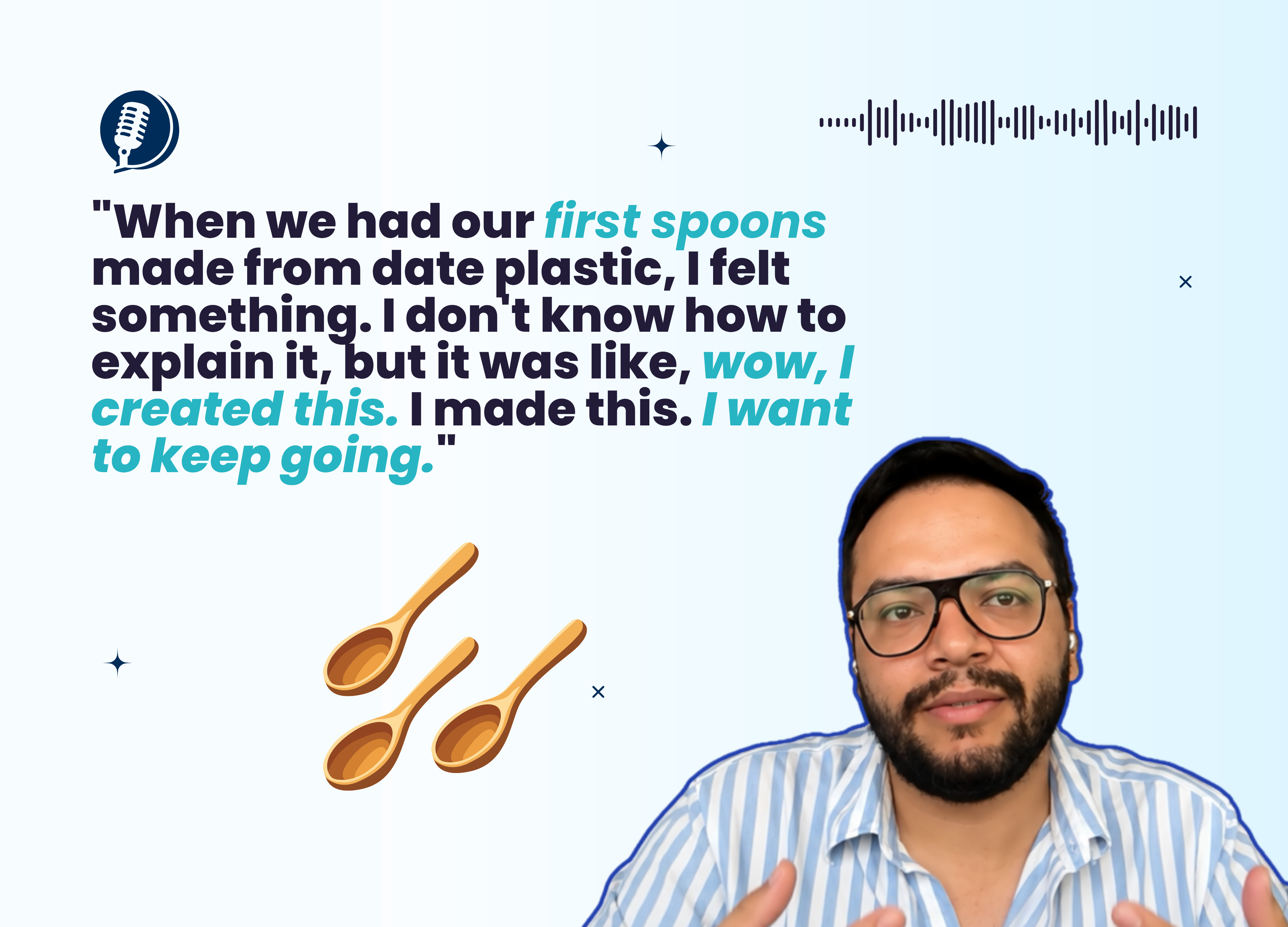
This happened in the middle of the hardest stretch of his PhD, right after the cofounder conflict that almost made him quit everything. The spoon was not a trophy. It was relief. It was the first physical proof that eight years of holding on had produced something that fit in his hand.
The systems that hold for a decade are not sustained by motivation. They run on small material proofs, spread out over time, that tell the founder the path is going somewhere.
A system of people
At the end of the interview I asked the question I ask every guest: if you could pass on a single sustainable system to the next generation, which one would it be?
Rodrigo did not talk about technology.
“Having a system of people who help you push forward. We always need someone telling us we’re doing well. And sometimes you need a break. Take a weekend off and you’ll see things look different.”
Then, without being asked, he added the harder part:
“There has to be a balance. If you surround yourself with people who tell you all the time that you’re doing great, you go blind. But if you surround yourself with people who are too negative, you catch their energy.”
I shared with him something I heard at a Tony Robbins event two years ago. A makeup entrepreneur was talking about the microphone: who you turn the volume up for and who you don’t. Her rule was simple. You turn up the volume for whoever already did what you’re trying to do. Whoever has the case, the numbers, the scar. You turn it down for the rest, not because they don’t matter as people, but because opinion on paper and opinion with a scar are different languages.
Rodrigo confirmed the analogy in his own words. The most critical system Polymeron built was not chemical. It was an architecture of who gets a microphone and who does not.
What we also talked about in the interview
How growing up in Mexico City gave Rodrigo the resilience to build in Arabia. A city that builds character, that teaches you to ask for things.
What Arabia gave him that Mexico had not: the habit of getting to know the person before the deal. Endless tea and coffee before talking about numbers.
The most concrete cultural difference he learned. The day of the KAUST orientation in 2012 when he extended his hand to a Saudi student, and she, embarrassed, explained that it wasn’t the custom.
His next steps: consolidate Saudi Arabia, expand across the Gulf, and eventually take the model to Mexico with avocado waste and to Brazil with a local palm whose name he couldn’t recall during the interview.
The full audio is above.
What you can do tomorrow
Three questions to check your own system, not Rodrigo’s:
What non-dilutive grant, competition, or fund exists in your industry that you’ve been postponing to apply for because “this doesn’t apply to us”?
Who are you turning up the microphone for who has not gone through what you’re building?
What’s the first “spoon” you need to see come out to know the system you’re building is actually working, and how far are you from holding it in your hand?
This is the third case study in the Aziul Connections series. The first was Esteban Sánchez-Canepa, CTO of Sadeem Technology and KAUST alumnus, on what really sustains a founder when the external system collapses. The second was Hassan Bash, a Saudi-American operations consultant, on the diagnostic question he uses with every founder before taking them on as a client. The next one comes soon.
Follow Rodrigo and Polymeron
Rodrigo Jiménez Sandoval on LinkedIn: linkedin.com/in/rodrigo-jimenez-sandoval-
Polymeron on LinkedIn: linkedin.com/company/polymeronksa
Polymeron website: polymeron.com
Subscribe to Aziul Connections (The Sustainable Systems Lab)
Public lab studying sustainable systems across business, leadership, and life. Essays, experiments, field observations and case studies from a climate-tech founder (Dr. Luisa Javier) operating between LATAM and MENA. Aziul = Azul (the planet) + Luisa (backwards)
About the author - Dr. Luisa Javier
Dr. Luisa Javier is a scientist and climate-tech entrepreneur across LATAM & MENA, focused on designing sustainable systems for business and society. She is the Founder and CEO of WAYAKIT Group and the author of Aziul Connections.
Aziul Connections is the public lab where I study how sustainable systems are built.
“I build sustainable living through WAYAKIT, and study the systems behind it through Aziul Connections.”
Thank you for reading or listening to this article, share it or leave a comment if you find this information useful!
Luisa
Connect with me
LinkedIn · Instagram · Facebook · Snapchat · TikTok
Further reading:
1. OECD (2022), “Plastic pollution is growing relentlessly as waste management and recycling fall short,” OECD Newsroom.
2. KAUST (2025), “Turning date waste into ‘green’ plastic: KAUST startup Polymeron champions circular economy,” KAUST News.
3. AGBI (2025), “The Saudi quest to turn campus ideas into startup success,” Arab Gulf Business Insight.