


Highlights
Putting out fires is not the same as fixing them
The founder who checks everything is not being responsible. They are becoming the bottleneck
TAPPPP is not a planning framework. It is a diagnostic that tells you which thread to pull first
Emergency systems do not announce when they fail. They become normal
Knowing which dimension is broken completely changes what you do tomorrow
👋 Hi, it’s Luisa Javier. Welcome to Aziul Connections ( 🌎🔬The Sustainable Systems Lab), where I study how sustainable systems are built for business, leadership, and life.
🎧 Listen to Luisa read this article
The Day I Became the Problem
We were losing clients and I could not understand why.
The proposals were going out. The pricing was there. But something was not landing. When I sat down to review how the sales team was building quotations, I saw the problem: they were only looking at costs and adding a margin. No market analysis. No reflection of the additional savings WAYAKIT delivers to the client. The entire value proposition was missing from the number.
So, I pulled everything toward me. Not out of control. Out of urgency. We could not keep sending proposals that were not properly built.
It worked, partially. I started seeing things I had not seen before. Where the real friction was. Why clients were not reacting. What needed to change. I adjusted it. Refined it. And in that process, I learned something valuable about how WAYAKIT communicates its value.
But once I fixed it, I kept doing it myself. Without building a mechanism for it to run without me.
Within weeks, the sales team could not send quotations on time. The pricing improved. The agility collapsed. And I was repeating the same task over and over, becoming the single point everything had to go through.
I had not solved the proposal problem. I had dug my own hole.
The Fire That Keeps Coming Back
What I experienced with WAYAKIT’s quotations was not a delegation mistake. It was a diagnosis mistake.
I identified the symptom and applied the fastest available solution. But I never asked what actually mattered:
What is failing in the system that is producing this problem?
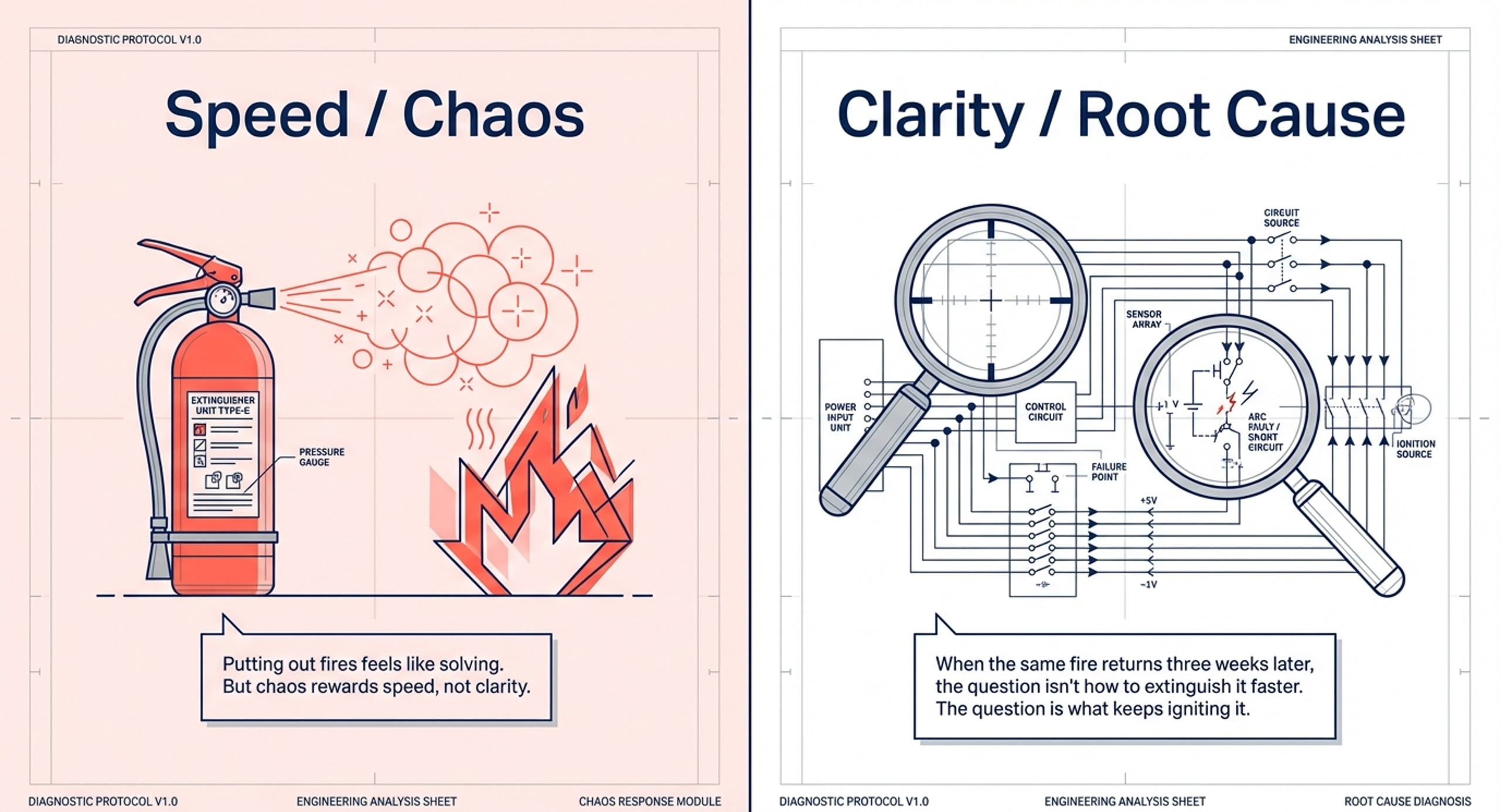
This is what founders do in chaos. Not because we are bad operators. Because chaos rewards speed, not clarity.
Putting out fires feels like solving. And sometimes it is. But when the same fire comes back three weeks later, somewhere else in the business, wearing a different face, the question is no longer how to put it out faster.
The question is what is lighting it.
Ken Rutkowski describes this in When the Founder Becomes the Bottleneck: bottlenecks do not announce themselves. They accumulate. The team stops deciding and starts asking. Nothing breaks all at once. Everything just moves slower.
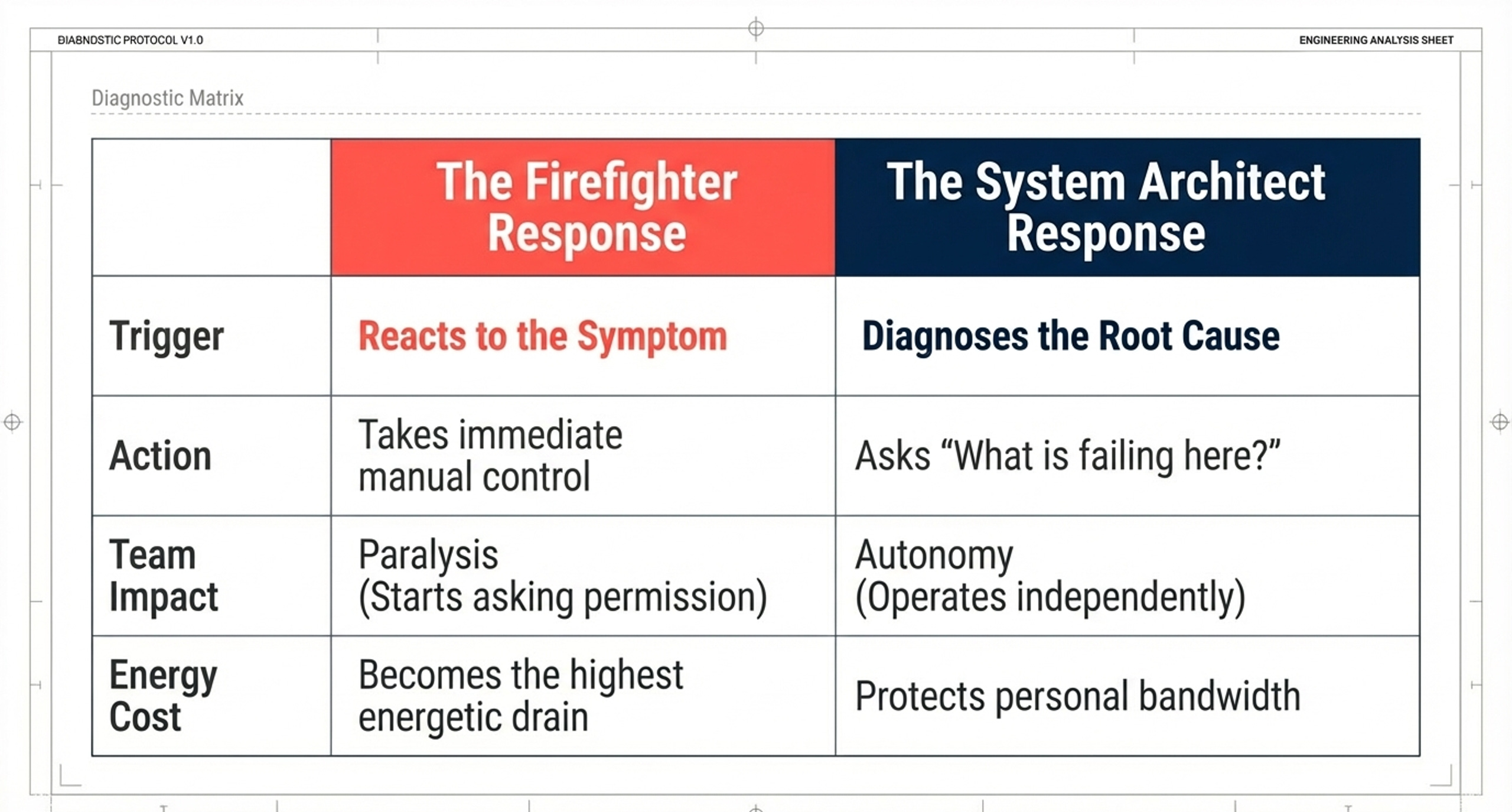
Matt Gray goes one layer deeper, Everyone is Exhausted. Here’s Why It’s Not Burnout (Founder OS): exhaustion does not come from doing too much. It comes from being too many things at once. When you are the system, you do not just become the operational bottleneck. You become the highest energy cost in the business.
A system always produces something, whether you designed it or not. The hidden output of mine was dependency.
In the Foundational Paper 000 in Aziul Connections, I wrote about Donella Meadows’ definition: a system is a set of interconnected elements organized to achieve something. What Meadows points to, and what I learned the expensive way, is that the real purpose of a system is not always the one you think you built.
My quotation system had a declared purpose: improve quality. Its real purpose, the one it reliably produced, was centralization around me.
What TAPPPP Asks When You Are Already Mid-Air
When I hit the limit, I did not sit down to write a strategic plan. I did what I always do when something starts draining my life: I stopped. And I asked what was actually failing.
TAPPPP is not a framework for when you have time and clarity. It is a diagnostic for when you are already mid-air and need to know which thread to pull first.
Six questions. One per dimension. I do not apply them to the whole business. I apply them to the specific system that is failing.
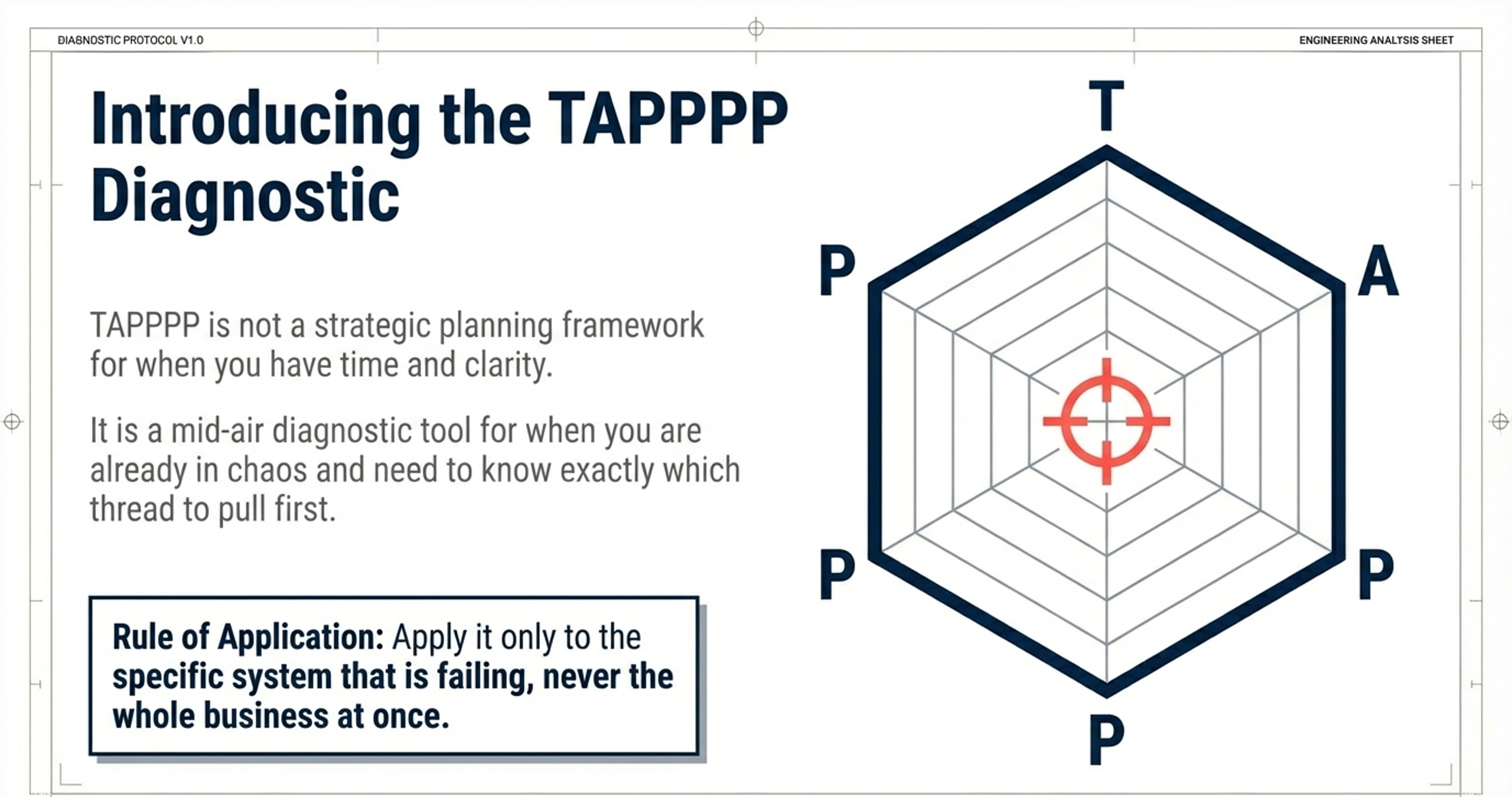
Time: Does this system give me time back, or consume it every time I activate it?
Adaptability: Does it still work when I am not there, when the team changes, when the context shifts?
Purpose: Does this system serve the business, or does it serve my need for control?
People: Does it strengthen the people inside it, or make them dependent on me?
Planet: What resources, energy, or capacity is it consuming that it should not?
Prosperity: Can it sustain itself without my constant intervention, or does it collapse when I step away?
When I applied these questions to my quotation system, the answer was the same across five of the six filters: no.
I did not need more discipline. I needed to redesign one thing.
I was taking on debt to buy my freedom back later.
With a data science intern, we built an intelligent pricing system that automated the logic I had been applying manually. Quotations went out on time. Pricing reflected WAYAKIT’s real value. And I stopped being the system.
In Experiment 001 — The Continuity Floor, I documented what happens when this diagnostic is applied not only to a business process, but to a person’s full ability to keep operating under friction. The conclusion was the same:
Motivation fails exactly when you need it most. Structure does not.
The Thread You Need to Pull Today
Right now, there is a fire in your business that keeps coming back. You know it. You have probably put it out twice this week already.
Before you put it out a third time, take that specific system and run it through the six filters. Not to build a plan. To see which dimension is broken.
Matt Gray frames it from another angle: The One Choice That Will Determine Your Next 10 Years (Founder OS): the next ten years of your business are defined by what you remove, not what you add. A system-oriented founder does not do more. They identify what is failing and redesign only that.
One broken dimension can collapse everything else. But once you see it, you know exactly what to change.
The question is not how to work faster.
It is what your current system is producing right now, whether you intended it or not.
What is the fire you have put out the most this month?
Tell me in the comments. What you name, you can begin to design.
Subscribe to the experiment. You are not alone in this.
Subscribe to Aziul Connections (The Sustainable Systems Lab)
Public lab studying sustainable systems across business, leadership, and life. Essays, experiments, field observations and case studies from a climate-tech founder (Dr. Luisa Javier) operating between LATAM and MENA. Aziul = Azul (the planet) + Luisa (backwards)
About the author - Dr. Luisa Javier
Dr. Luisa Javier is a scientist and climate-tech entrepreneur across LATAM & MENA, focused on designing sustainable systems for business and society. She is the Founder and CEO of WAYAKIT Group and the author of **Aziul Connections.**
Aziul Connections is the public lab where I study how sustainable systems are built.
“I build sustainable living through WAYAKIT, and study the systems behind it through Aziul Connections.”
Thank you for reading or listening to this article, share it or leave a comment if you find this information useful!
Luisa
Connect with me
LinkedIn · Instagram · Facebook · Snapchat · TikTok
Sources:
***Meadows, D. H. (2008), “Thinking in Systems: A Primer,” Chelsea Green Publishing.***
***Rutkowski, K. (2026), “When the Founder Becomes the Bottleneck,” Command and Scale, Substack.***
***Gray, M. (2026), “Everyone is Exhausted. Here’s Why It’s Not Burnout,” Founder OS, Substack.***
***Gray, M. (2026), “The One Choice That Will Determine Your Next 10 Years,” Founder OS, Substack.***