


Key points
Next to many kitchen sinks sits a small bowl of soapy water. Inside it, a sponge that never gets the chance to dry.
Researchers found zones inside used kitchen sponges with up to 54 billion bacteria per cubic centimeter.
An antibacterial dish soap failed to reduce Salmonella or E. coli in sponges with food residue within 24 hours.
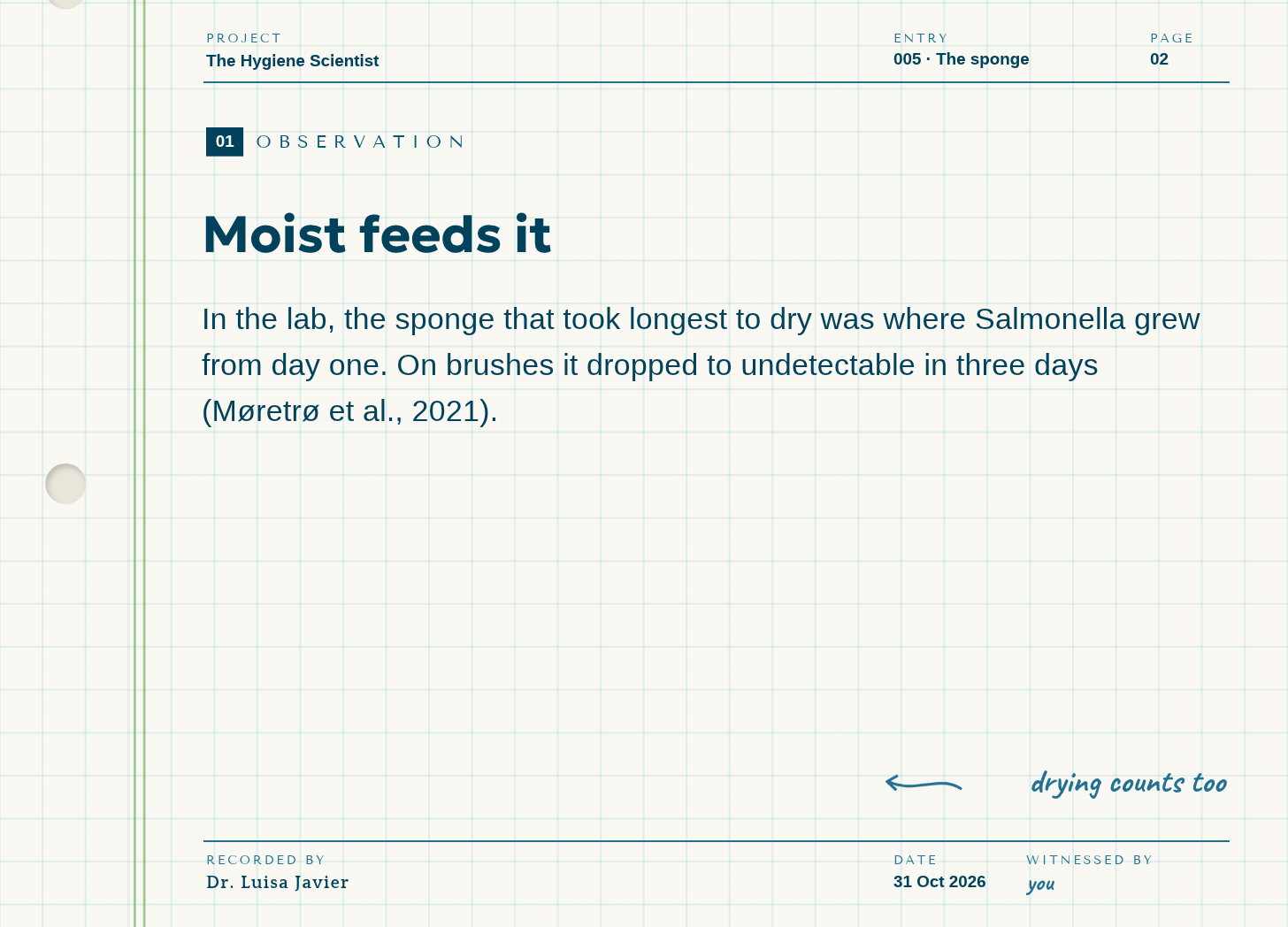
In the lab, the sponge that took longest to dry was the one where Salmonella grew from day one.
Disinfect it, squeeze it until it stops dripping, let it dry out of the water and replace it every week.
👋 Hi, it’s Dr. Luisa Javier, The Hygiene Scientist. Welcome to Aziul Connections (🌎🔬 The Sustainable Systems Lab), where I study how sustainable systems get built for business, leadership, and life.
The little bowl next to the sink
In homes in Mexico and in homes in Saudi Arabia I have seen the same scene. Next to the sink sits a small bowl with water and a squirt of dish soap. The sponge gets dipped there for washing, and often it stays inside all night, with bits of food floating around it. Two or three days later the water starts to smell awful, and the sponge is still there.
If you have ever wondered how often to replace your kitchen sponge, here is the short answer. A used sponge can hold up to 54 billion bacteria per cubic centimeter in its most crowded spots, according to a study of 14 used sponges in Germany. What helps them grow most is moisture. Disinfect the sponge as its label says, squeeze it until it stops dripping, let it dry out of the water and replace it every week.
Why a sponge is the perfect home for biofilm
A biofilm is a community of bacteria that sticks to a surface and ends up wrapped in a matrix the bacteria make themselves, a kind of glue made mostly of proteins and sugars (Javier et al., 2021; Farhat et al., 2019). It forms in stages: a few bacteria attach, gather into colonies, start releasing that matrix and grow in layers. The matrix protects them from what happens outside, and once the biofilm matures it releases bacteria that go on to colonize other surfaces (Javier et al., 2022).
My PhD was on biofilm in desalination membranes, and that is where the studies I just cited come from. Same enemy: a living layer that sticks, protects itself and comes back after you clean it. In one of those studies, the biofilm that grew on very little food was the hardest to remove with chemical cleaning (Farhat et al., 2019). In September 2025 I gave a talk at KAUST about cleaning and biofilm, and the idea that landed hardest was this one: biofilm looks less like dirt and more like a fortress.
A kitchen sponge gives that fortress everything it asks for. Thousands of pores to hide in, food scraps to eat and, if it lives in a bowl of water, moisture all day long.
A sponge that never dries is a house with a full pantry and the door left open.
How many bacteria fit in a used sponge
In 2017 a team of researchers in Germany, led from Furtwangen University, analyzed 14 used kitchen sponges collected from homes in the southwest of the country. They sequenced the bacterial DNA and looked inside the sponges with confocal microscopy. In the most crowded zones they estimated densities of up to 54 billion cells per cubic centimeter (Cardinale et al., 2017).
To picture it, think of a little cube one centimeter on each side, about the width of your pinky fingernail. In that space, in the most crowded parts of the sponge, there were about six and a half times more bacteria than people on the planet, and in 2024 we were 8.2 billion (UN, 2024).
That number describes the densest points inside the sponge, not an average for the whole thing. It still helps you see what you cannot see: the bacteria lived in the inner cavities and in biofilm like structures, not only on the surface your hand touches.
The same study found that five of the ten most abundant bacterial groups were related to risk group 2 species. That is the class for microorganisms that can cause disease under certain conditions, mostly in people with weaker defenses. No need to panic over it, but it is a good reason to treat the sponge as the object in your kitchen that collects and spreads the most bacteria.
What dish soap cannot do
Here is the detail the little bowl hides. Dish soap is made to cut grease, and most of it does not claim to disinfect. A group at Wageningen University tested an antibacterial dish soap on used sponges. In a test tube, at 2 to 4% concentration, every bacterium dropped below detection within 24 hours. Inside sponges with food residue, the same product did not significantly reduce E. coli or Salmonella in that time (Kusumaningrum et al., 2002).
The authors conclude that what works in a test tube does not necessarily work in the real conditions of a household sponge. So the soapy water in the bowl, with scraps floating in it, does not act as a disinfectant, even if it smells like lemon.
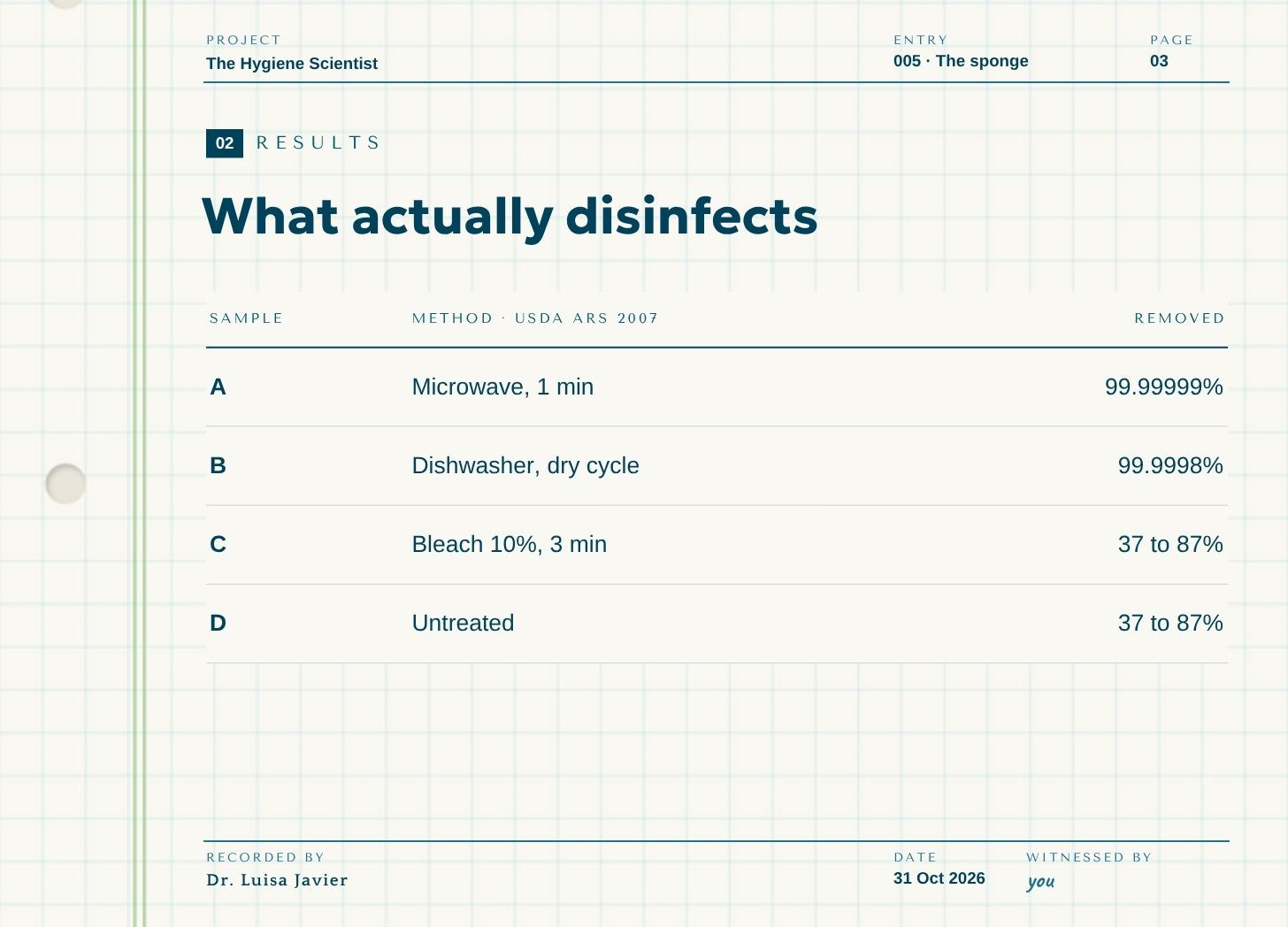
Soaking does not do it either when the time is short. In a study by the United States Department of Agriculture, sponges loaded with a mix of ground beef and culture broth were left for three minutes in a 10% household bleach solution. Bleach, lemon juice, plain water and the untreated sponge all landed in the same range: between 37 and 87% of bacteria killed (Sharma et al., 2009; USDA ARS, 2007).
Smelling clean and being disinfected are measured with different instruments.
Drying matters as much as disinfecting
This is the step almost nobody mentions and the one I defend the most. In 2021 a team from Nofima in Norway, together with the Portuguese Catholic University, surveyed 9,966 people in ten European countries about how they wash dishes, then tested in the lab how bacteria survive on sponges and on brushes (Møretrø et al., 2021).
The brushes dried faster, and on them Salmonella fell below detection within three days. On two of the three sponge types, Salmonella survived more than seven days.
The clearest difference showed up in the sponge that took longest to dry. There Salmonella grew from the first day and stayed higher than in the other sponges.
The logic is simple. Bacteria need water to grow, and biofilm stores water for them. Squeeze the sponge until it stops dripping and leave it where air can reach it, and you take away the fortress’s main resource. Leave it in the bowl, and you hand it over all day.
Disinfecting goes after the bacteria. Drying takes away the water they need to come back.
How often should you replace a kitchen sponge?
The authors of the German study recommend replacing it about once a week instead of relying on washing it again and again (Furtwangen University press release, 2017). In their data, the sponges their owners cleaned regularly in the microwave or with hot water had a larger share of potentially pathogenic bacteria, and two of the dominant groups were more abundant in them (Cardinale et al., 2017).
That does not mean heat is useless. In the Department of Agriculture study, one minute in the microwave at full power, with the sponge wet, killed 99.99999% of the bacteria, and a dishwasher cycle with heated drying killed 99.9998% (USDA ARS, 2007). The difference is time. Disinfecting leaves the sponge clean today, but if it stays wet and full of food, the community grows back.
So I think of three layers that work together. The first is physical: rinse and squeeze to get food and water out. The second is chemical or thermal: a disinfectant with the contact time its label asks for, or heat. The third is replacement: a new sponge every week, or sooner if it smells, feels slimy or you wiped up raw meat juices with it.
What I do at home tonight
My habit is short. When I finish washing up, I put disinfectant on the sponge, wait the time on the label and squeeze it hard, as hard as I can, until no more water comes out. Then I stand it upright, outside any container, where the air can reach it.
At home the disinfectant I use is from WAYAKIT. I am the founder, so take it for what it is: the one I have on hand. Any disinfectant registered for kitchen surfaces works if you follow its label. The part that changes the result most costs nothing, and it is the squeeze.
If your kitchen has the little bowl, try this tonight. Pour out the water, wash the container and leave the sponge outside it, squeezed. Touch it tomorrow before you start washing. If it is dry, you already took the bacteria’s best night away.
Where does the sponge sleep in your kitchen?
The habit that protects your family most at the sink is free and lasts as long as a squeeze.
What comes next
The sponge is the closest example of something that also happens inside your water filter and your pipes: a community that sticks, protects itself and waits for moisture. Next week I write about that, and how to know when to change your filter without relying on your nose.
If you missed the last essay, that is where I tell why a water scientist became The Hygiene Scientist.
Three more questions about your sponge
Does boiling the sponge work?
Yes. In the 2021 European study, boiling was one of the methods that reduced Salmonella effectively, along with bleach and the dishwasher. Like microwave heat, it leaves the sponge clean that day; if it then stays wet and full of food, the bacteria come back.
Does a new sponge already come with bacteria?
In the 2017 German study, the researchers found no microbial contamination in freshly bought sponges. What fills a sponge is daily use, with food and moisture. That is why the weekly change makes a difference.
Should I switch to a brush?
The authors of the European study concluded that a brush is more hygienic than a sponge for washing dishes and recommend using one. If you switch, the same rule applies: shake it out and let it dry standing up, out of the water.
Luisa Javier · The Hygiene Scientist
Full episodes of The Hygiene Scientist arrive on YouTube in January. Shorts are already there: @thehygienescientist.
Subscribe to Aziul Connections (The Sustainable Systems Lab)
Public lab studying sustainable systems across business, leadership, and life. Essays, experiments, field observations and case studies from a water scientist and founder (Dr. Luisa Javier) operating between LATAM and MENA. Aziul = Azul (the planet) + Luisa (backwards)
About the author: Dr. Luisa Javier
Dr. Luisa Javier is a water scientist (PhD, KAUST), The Hygiene Scientist, and an entrepreneur across LATAM and MENA, focused on designing sustainable systems for business and society. She is the Founder and CEO of WAYAKIT Group and the author of Aziul Connections.
Aziul Connections is the public lab where I study how sustainable systems are built.
“I build sustainable living through WAYAKIT, and study the systems behind it through Aziul Connections.”
Thank you for reading or listening to this article, share it or leave a comment if you find this information useful!
Luisa
Connect with me
LinkedIn · Instagram · Facebook · Snapchat · TikTok · YouTube
References
Javier, Farhat and Vrouwenvelder (2021), “Enhanced hydraulic cleanability of biofilms developed under a low phosphorus concentration in reverse osmosis membrane systems,” Water Research X, 10, 100085. DOI: 10.1016/j.wroa.2020.100085
Farhat, Javier, Van Loosdrecht, Kruithof and Vrouwenvelder (2019), “Role of feed water biodegradable substrate concentration on biofouling: Biofilm characteristics, membrane performance and cleanability,” Water Research, 150, 1 to 11. DOI: 10.1016/j.watres.2018.11.054
Javier, Pulido Beltran, Vrouwenvelder and Farhat (2022), “Permeation increases biofilm development in nanofiltration membranes operated with varying feed water phosphorous concentrations,” Membranes, 12(3), 335. DOI: 10.3390/membranes12030335
Cardinale, Kaiser, Lueders, Schnell and Egert (2017), “Microbiome analysis and confocal microscopy of used kitchen sponges reveal massive colonization by Acinetobacter, Moraxella and Chryseobacterium species,” Scientific Reports, 7, 5791. DOI: 10.1038/s41598-017-06055-9
United Nations (2024), “World Population Prospects 2024,” press release, July 2024 (8.2 billion people in 2024).
Kusumaningrum, Van Putten, Rombouts and Beumer (2002), “Effects of antibacterial dishwashing liquid on foodborne pathogens and competitive microorganisms in kitchen sponges,” Journal of Food Protection, 65(1), 61 to 65. DOI: 10.4315/0362-028X-65.1.61. Currency note: source older than 10 years; used because it measures exactly this question.
Sharma, Eastridge and Mudd (2009), “Effective household disinfection methods of kitchen sponges,” Food Control, 20(3), 310 to 313. DOI: 10.1016/j.foodcont.2008.05.020. Currency note: source older than 10 years.
USDA Agricultural Research Service (2007), “Best ways to clean kitchen sponges,” research news, 23 April 2007. Currency note: source older than 10 years, archived page.
Møretrø, Moen, Almli, Teixeira, Ferreira, Åsli, Nilsen and Langsrud (2021), “Dishwashing sponges and brushes: consumer practices and bacterial growth and survival,” International Journal of Food Microbiology, 337, 108928. DOI: 10.1016/j.ijfoodmicro.2020.108928
Hochschule Furtwangen, via idw (2017), “The kitchen sponge: breeding ground for germs,” press release, 19 July 2017.