


Highlights
I looked at what the internet teaches about cleaning. Almost all of it was hacks with no explanation.
Your eyes see dirt and your nose smells product. Neither one can see a microbe.
I studied biofilm on desalination membranes. The same enemy lives in your sponge and your water tank.
Clean is a feeling. Proving it is a system, and it fits in three questions you can ask anywhere.
What was it cleaned with? How long did it stay wet? How do you know? That’s where The Hygiene Scientist begins.
👋 Hi, I'm Dr. Luisa Javier, The Hygiene Scientist, building The Sustainable Systems Lab. Welcome to Aziul Connections 🌎🔬, where I study the systems that keep things working, and how to prove that they do.
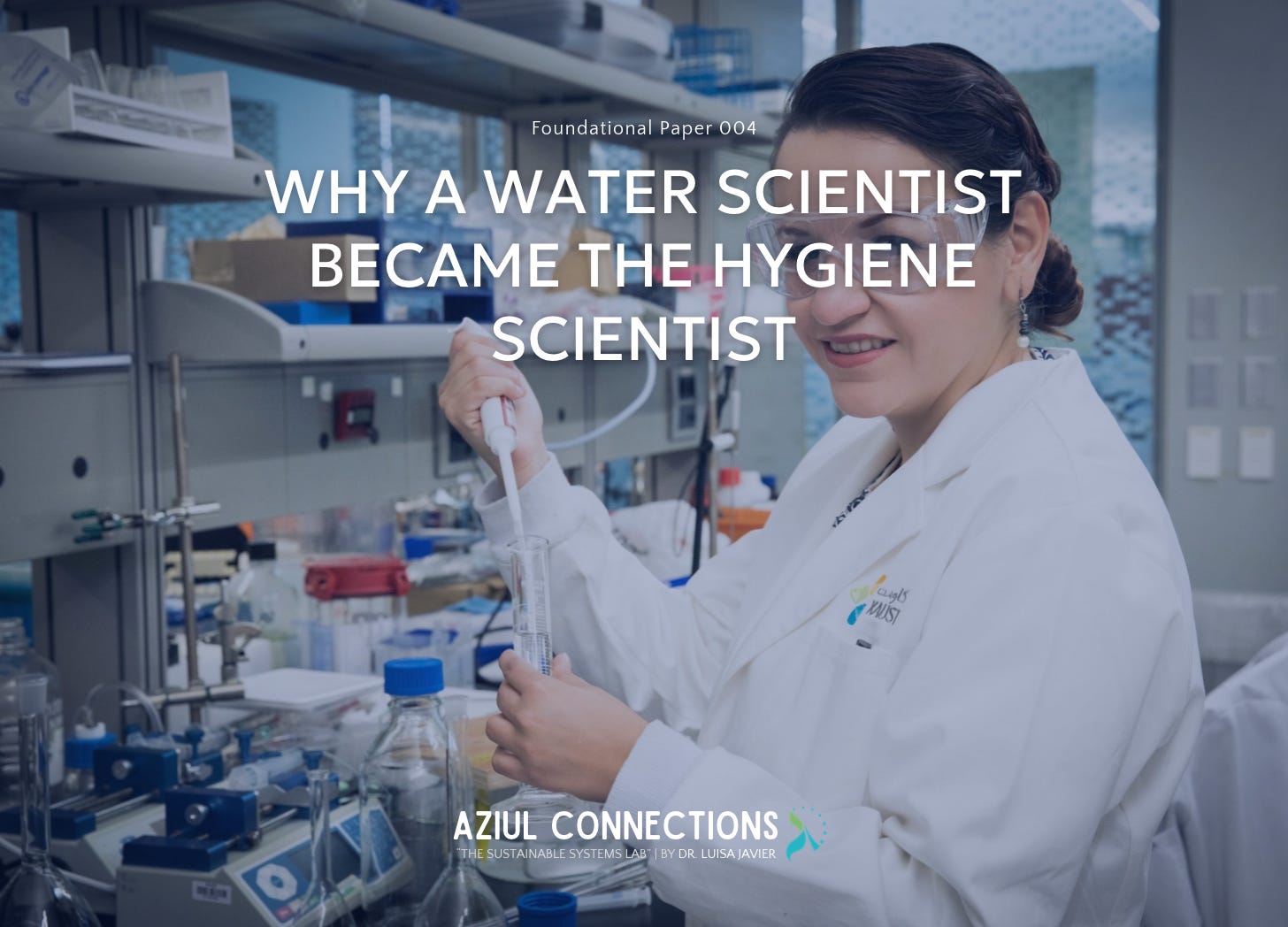
What I found when I looked at how cleaning is taught
A few weeks ago I sat down with the data: what people search about cleaning on Google and YouTube, and what they ask on social media. I wanted to know what is being taught. I ended up annoyed. What the public gets is hacks: spray this, mix that, scrub with whatever is in the pantry. Almost none of them explain why it would work, and none tell you how to know if it did.
Meanwhile, the comments kept asking the same thing in different words: it looks clean, it smells clean, so is it clean?
How do you know if something is clean when it looks and smells clean?
Your senses alone can’t tell you. Your eyes detect dirt and your nose detects the product, but the microbes that make people sick are invisible. To get closer to the answer you need three facts: what it was cleaned with, whether the surface stayed wet as long as the label asks, and what evidence shows it worked.
A clean smell describes the product you used. It says nothing about what’s left on the surface.
Clean is a feeling. Proving it is a system.
Why a water scientist
I’m a water scientist. I did my PhD at KAUST, in Saudi Arabia, on controlling biofilm on desalination membranes. Biofilm is a community of microorganisms stuck to a surface and wrapped in a layer they make themselves (Flemming and Wingender, 2010). That layer protects them from whatever we use to remove them. In a desalination plant, biofilm clogs a membrane a little more each week. At home it lives in your sponge, in the tinaco (the water tank on Mexican rooftops) and in the dogs’ water bowl.
I spent years measuring something you can’t see, in a country where tap water started out as seawater. So when I saw what gets taught about cleaning, I recognized the gap: almost nobody asks how we know something worked. That question is my job. It’s where the name comes from: The Hygiene Scientist, the scientist who asks how clean something really is and teaches you to ask it too.
I live between Mexico and Jeddah, and both homes bring me the same doubts in different clothes: the tinaco on the roof against the building’s tank, the garrafón, the big refill jug, against desalinated water.
The three questions of The Hygiene Scientist
These three questions are the foundation of everything I’ll publish under this name. They work in your kitchen, in a hotel or on a plane.
1. What was it cleaned with? Cleaning removes dirt and disinfecting kills microorganisms. They are different steps, and often the second one doesn’t work without the first. What a product can do is written on its label; the smell won’t tell you.
2. How long did it stay wet? Every disinfectant needs the surface to stay wet for a certain time to work. That’s called contact time, and it’s on the label (American Chemistry Council, 2025). If you spray and wipe dry in a few seconds, you’re most likely not reaching it.
3. How do you know? This is where evidence comes in: a measurement, a log, a label read properly, a study. Sometimes the answer will come from something I measure, sometimes from what I observe in the field, and sometimes from what someone else already published. I’ll always tell you where it came from.
To stop guessing, you only need to know what to ask.
Where The Hygiene Scientist lives
Aziul Connections is my lab: here I study the systems that keep things working, and how to prove that they do. For now water and hygiene carry more weight, because they are my science and my mission. The Hygiene Scientist is the tag that gathers everything about hygiene inside the lab.
Starting today it also has its own channels. On Instagram and TikTok, as @thehygienescientist, you’ll find short pieces in English. The YouTube channel opens in January.
One thing you can do today
Grab the disinfectant in your kitchen and find the contact time on the label. Next time you use it, count that time before you wipe the surface dry.
And a question for you: what cleaning doubt do you have at home, or in a place you use but don’t control? Reply to this email or leave it in the comments. The ones that come up most become the next pieces.
Frequently asked questions
Are cleaning and disinfecting the same thing? No. Cleaning removes visible dirt and disinfecting kills microorganisms. Many disinfectants work better on a surface that has already been cleaned, and the label usually says so.
What is contact time? It’s how long the surface has to stay wet with the disinfectant for it to work. It changes from product to product and it’s printed on the label.
Does a bleach smell mean the surface is disinfected? Not necessarily. The smell tells you there was product; it doesn’t tell you how long it acted or whether it was the right one for what you wanted to remove.
Luisa Javier · The Hygiene Scientist
Subscribe to Aziul Connections (The Sustainable Systems Lab)
A public lab on the systems that keep things working, and how to prove it. Water and hygiene first, because they are my science and my mission; from there, business, leadership and life. Essays, experiments, field observations and case studies by Dr. Luisa Javier, between Mexico and Saudi Arabia. Aziul = Azul (the planet) + Luisa (reversed)
About the author: Dr. Luisa Javier
Dr. Luisa Javier is a water scientist (PhD, KAUST) and The Hygiene Scientist. She studied biofilm on desalination membranes, is the founder and CEO of WAYAKIT Group and writes Aziul Connections, The Sustainable Systems Lab.
Aziul Connections is the public lab where I study how sustainable systems are built.
“I build sustainable living through WAYAKIT, and study the systems behind it through Aziul Connections.”
Thank you for reading or listening to this article, share it or leave a comment if you find this information useful!
Luisa
Connect with me
LinkedIn · Instagram · Facebook · Snapchat · TikTok
References
Flemming, H. C. and Wingender, J. (2010), “The biofilm matrix,” Nature Reviews Microbiology, 8(9), 623 to 633. DOI: 10.1038/nrmicro2415
American Chemistry Council (2025), “How to read a disinfectant product label,” Chemistry in America.