


Key points
You smell the jug, see it is clear, and decide it is fine. That check cannot see the one thing that matters.
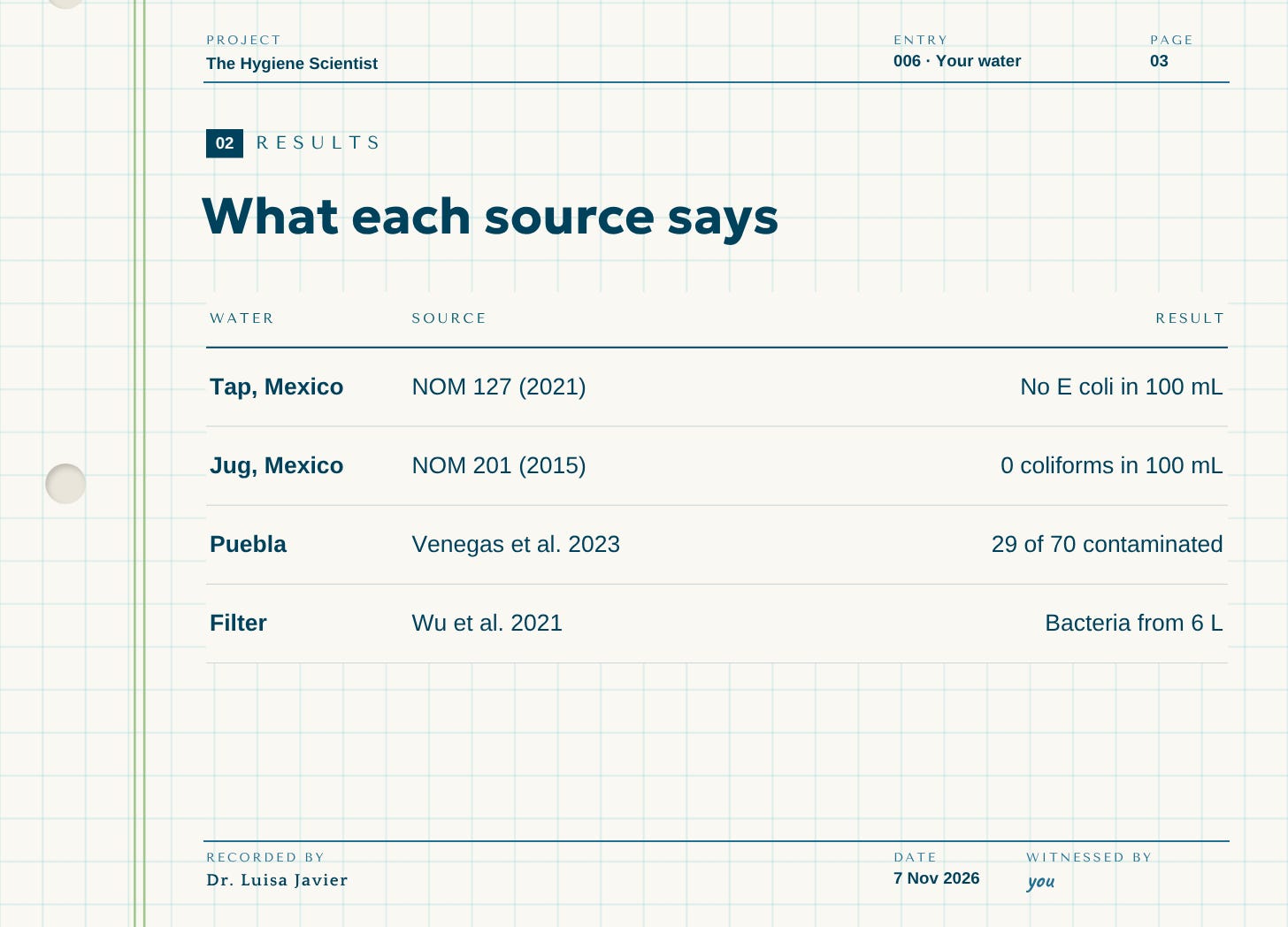
Safe water has a number: zero E coli in 100 milliliters, less than half a glass. You cannot smell that number.
In my PhD we knew a membrane had biofilm from the water pressure. Never from the smell: it smelled of nothing.
In a study in Puebla, Mexico, 29 of 70 jugs from small refill shops were contaminated. Almost two in every five.
Your next step fits in one question for your water supplier: can I see your latest coliform test?
👋 Hi, I’m Dr. Luisa Javier, The Hygiene Scientist. Welcome to Aziul Connections (🌎🔬 The Sustainable Systems Lab), where I study how sustainable systems get built for business, leadership, and life.
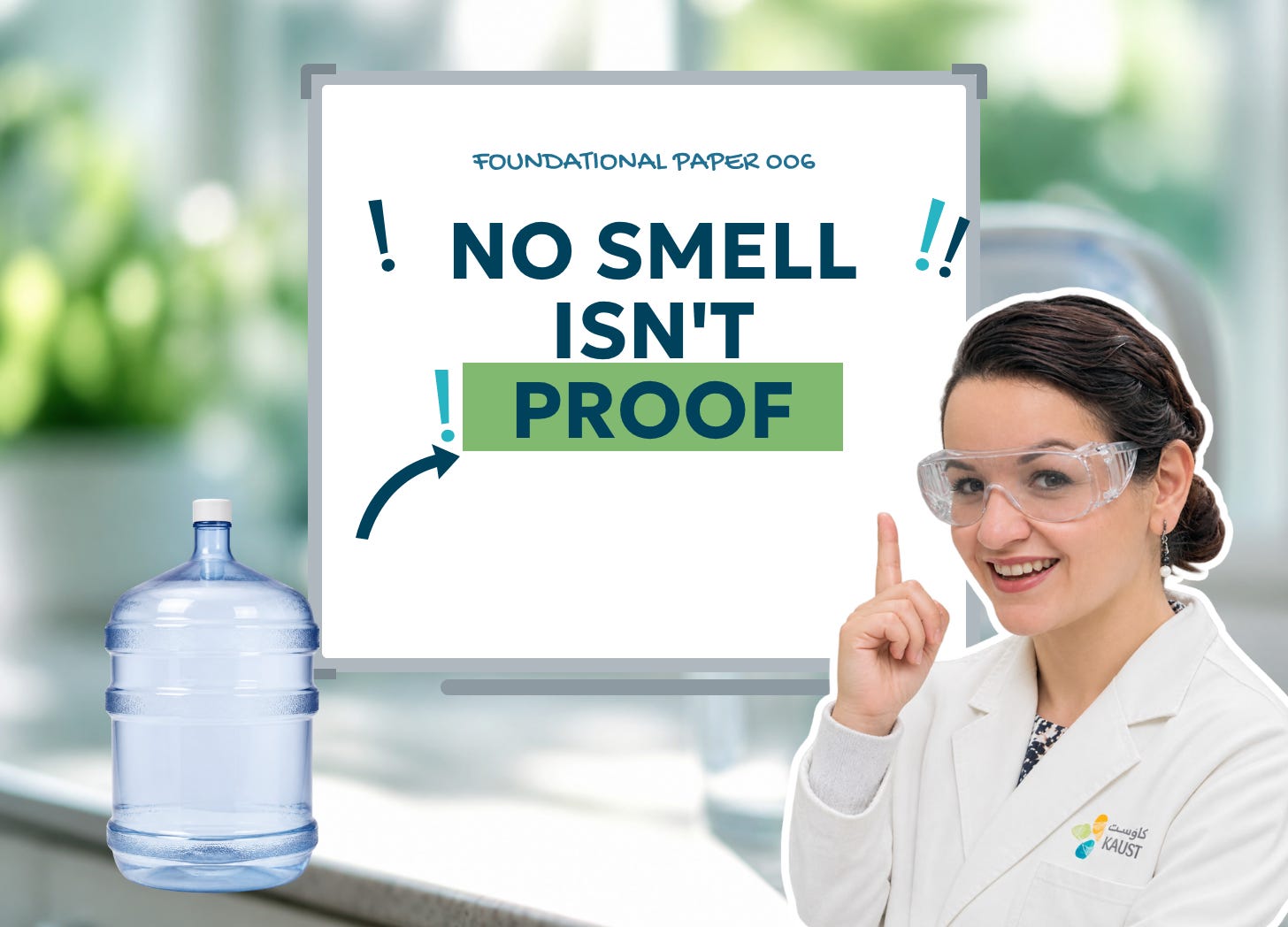
You open a new water jug, lean in, and it smells like nothing. You hold it up to the light and it looks crystal clear. That is enough for you to decide your family can drink it. I grew up in a home in Mexico with a 20 liter garrafón, and for years my only check was that same one.
The short answer: the water you drink at home is safe when a laboratory does not detect E coli in 100 milliliters. Smell, color and a dissolved solids meter cannot tell you that. Between one test and the next, what you look after depends on where your water comes from: the jug, the tap, the filter or the bottle.
A few weeks ago, in the comments under a video about filters, a woman explained her method. She never measures anything, because after about 30 days the water in her pitcher starts to smell fishy, like a pond, and that is how she knows it is time to change the filter. It is the same method I used with the jug: trusting my senses. This essay is about why the senses arrive late and what to use instead.
How do I know if the water I drink is safe?
Drinking water standards use one bacterium as an indicator: E coli. The Australian Drinking Water Guidelines, from the National Health and Medical Research Council (NHMRC), say that E coli should not be detected in a sample of at least 100 milliliters, and that if it appears, corrective action must be immediate. The same body describes it as an indicator organism for other bacteria, viruses and parasites.
One hundred milliliters is less than half a glass. If your everyday glass holds 250 milliliters, the sample fills two fifths of it.
Mexico asks for the same at the tap. Its official standard for drinking water, NOM 127 of 2021, published in the federal gazette in May 2022, sets E coli as not detectable in 100 milliliters.
Jugs and bottled water follow a different Mexican standard, NOM 201 of 2015. It asks for zero total coliforms, a wider group of bacteria the standard uses as its criterion, in 100 milliliters, and for the plant to test for them every week.
Notice what the two have in common: neither one mentions smell or clarity.
The number that matters lives in a lab report.
In the lab we never smelled, we measured
In my PhD I studied biofilm on desalination membranes. A biofilm is a community of bacteria stuck to a surface and wrapped in a matrix they make themselves, the extracellular polymeric substances, or EPS (Javier et al., 2021).
On membranes, we described how it forms: bacteria attach, build colonies, release EPS, grow in layers and mature. Once they reach a certain mass, they release bacteria that go on to colonize other surfaces (Javier et al., 2022).
How did we know a membrane already had biofilm? From a number. We measured the differential pressure between the water inlet and the outlet, and when it rose, something was blocking the way. To see it we used optical coherence tomography (OCT), an instrument that shows the layer without opening anything. Because we fed the water with nutrients, the change showed up within days.
We never knew it by smell. A membrane covered in biofilm smelled of nothing.
Years later I have opened used carbon cartridges, and they look dirty. I have opened membrane rolls where some biofilms, not all, leave a yellow color. From that image I keep a single idea: whatever builds up inside a filter gives you no warning from the outside.
What builds up inside a filter shows when you open it. From the outside, it gives no warning.
Your nose is very sharp, but it cannot count bacteria
Back to the woman in the comments. Her nose works very well for certain things. The Australian guidelines explain that geosmin and 2 MIB, two compounds that smell earthy or musty, can be detected from 10 nanograms per liter. They also explain that the same water can seem fine to one person and unpleasant to another, or to the same person on different days.
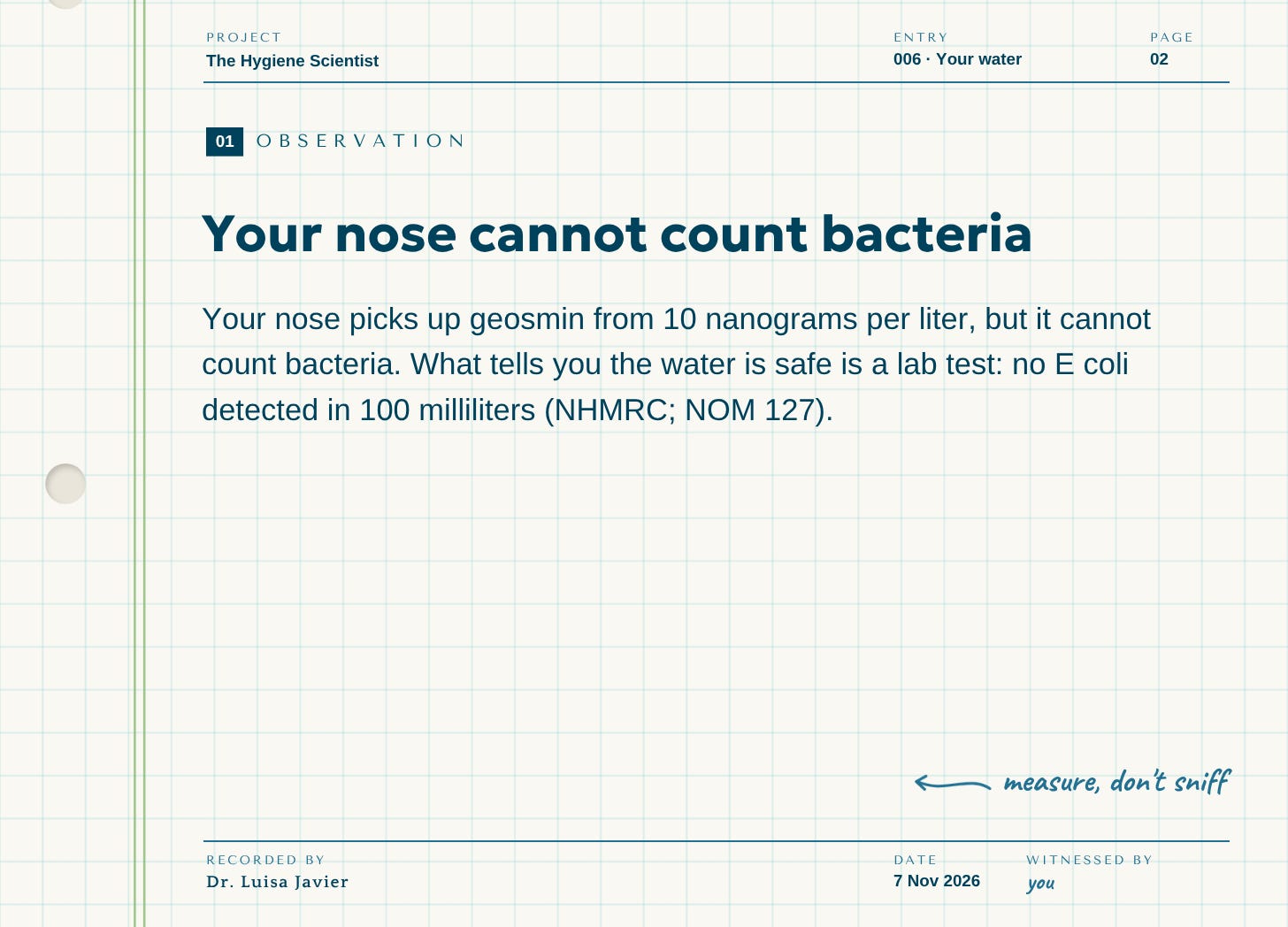
Ten nanograms per liter is one part in one hundred billion. It is like noticing one second inside roughly 3,200 years.
That nose has no way to count bacteria. A fishy smell may be telling you something, but water that smells of nothing is not telling you it is safe. I could not find a study that measures where the fishy smell in pitchers comes from, so I am not giving it a cause here.
The dissolved solids meter, that pen that shows a number in parts per million, measures the amount of compounds dissolved in the water, such as minerals and salts, without telling you which ones. The US Environmental Protection Agency (EPA) treats it as a separate test from the bacteria test: it recommends testing total coliform bacteria, nitrates, total dissolved solids and pH separately. A low number on your pen speaks about minerals. About bacteria, it says nothing.
Water that smells of nothing is not telling you it is safe.
The test that does answer the question
The EPA gives a simple rule for anyone who wants to test their home water: use only laboratories certified for drinking water testing.
In Mexico, what you ask for is a test for total coliforms, fecal coliforms and E coli. As a reference, an accredited testing laboratory in Guanajuato published a 2025 price of 447.30 Mexican pesos for that test using the most probable number method. The price list does not say whether tax is included.
The same laboratory charges 370.53 pesos for a presence or absence test, which only tells you whether bacteria are there or not, without counting them.
In Saudi Arabia, the Saudi Food and Drug Authority (SFDA) approves external laboratories to test drinking water. I could not find a published price.
When you order the test, bring a sample of the water your household actually drinks, and ask for the result to show E coli and coliforms in 100 milliliters. That way you can compare it against the standard without interpreting anything.
What you look after depends on where your water comes from
The jug
In a study in Puebla, Mexico, Venegas et al. (2023) tested 70 jugs of 20 liters bought from 25 small water refill shops, between March and November 2019. Of the 70, 29 were contaminated and did not meet the standard.
29 out of 70 is almost two in every five jugs.
The bacteria the authors characterized did not meet their criteria for opportunistic pathogens, and they still call for stricter sanitary monitoring. It is a study of one city and of small refill shops. It says nothing about your shop in particular, and that is exactly why it is worth asking.
The tap
Where water is disinfected with chlorine, NOM 127 asks for it to reach the tap with free residual chlorine between 0.2 and 1.5 milligrams per liter.
One milligram per liter is roughly one part in a million: one second inside about eleven and a half days.
That range is for the tap. For jugs, NOM 201 sets a maximum of 0.1 milligrams per liter.
The filter
A home filter gets changed by liters or by months, whichever comes first on its label, even if the water does not smell. The Rotoplas countertop purifier cartridge, common in Mexico, for example, says up to 2,400 liters and no more than 6 months of use, and warns that water with a lot of sediment wears it out sooner.
2,400 liters is 9,600 glasses of 250 milliliters.
Standard pitcher filters from a very common brand say 40 gallons, about 151 liters, or about two months for a household that drinks 11 glasses a day.
There is a reason not to wait for the smell. In carbon block filters for the tap, tested in a laboratory with inoculated water, Pseudomonas aeruginosa was already coming out in the filtered water within the first 6 liters, 1.5 percent of the filter’s design life (Wu et al., 2021).
Six liters is 24 glasses of 250 milliliters, about two days for that same household of 11 glasses a day.
In another study, with nine pitchers misused on purpose for five weeks, the bacteria in the filtered water rose week after week (Briancesco et al., 2020). The authors saw no serious risk for healthy people under those conditions and advise caution for people with weakened immune systems.
The bottle
In Mexico and in the Gulf, we place a lot of trust in bottled water. A 2024 study that compared purified and mineral bottled waters found that most purified waters had fewer than a thousand cells per milliliter, and that some natural mineral waters reached a million. The authors conclude that all of them met health regulations and that their microbial content was within the range expected for drinking water.
One milliliter is a tiny cube about as wide as your little fingernail. A million seconds is eleven and a half days.
What I do, from the jug to seawater
As a girl, we drank water from the jug at home and nobody asked anything. Today, subscription filters are growing in Mexico, and in theory they make sure the cartridge stays up to date. I do not know what their replacement schedule is, and that is exactly the question I would ask before signing up for one: how many liters or months before you change it, and where is that recorded?
Where I live today, the tap water comes from desalinated seawater, the process I studied during my PhD. In Saudi Arabia, as in Mexico, the people around me drink bottled water and trust it.
What I brought home from the lab works in my kitchen too: to know, you need a number. If I cannot measure today, I ask for someone else’s measurement.
One habit for tomorrow: a single question
Next time you buy a refill jug, ask the shop: can I see your latest coliform test? In Mexico, NOM 201 asks them to run it every week. I did not find that the standard requires them to show it to you, so take it as a customer’s question. If they show it to you, look for zero in 100 milliliters.
If you have a subscription filter, the question changes: when was the cartridge last changed, and how many liters had it filtered?
If you cannot measure today, ask for someone else’s measurement.
What is your everyday water, and who are you going to ask first?
Three more questions about the water in your home
Do home bacteria test kits work?
They work as a first signal. In an evaluation by the San Francisco water utility, three brands of coliform kits agreed with the laboratory more than 80 percent of the time. You have to wait the full incubation time, usually 48 hours, and treat the result as a first step. If it comes out bad, you confirm it with a laboratory.
Some branded kits have been through an independent evaluation. The Aquagenx E coli and coliform kit, tested by the KWR laboratory for the WHO and UNICEF water programme, correctly called whether E coli was present in 100 milliliters in 93 percent of tests incubated for 20 hours at 35 degrees Celsius, and in 90 percent with 48 hours at 25 degrees.
Does boiling make water safe?
Against microbes, yes. The US Centers for Disease Control and Prevention (CDC) say to bring clear water to a rolling boil for 1 minute, or 3 minutes above 6,500 feet, about 1,980 meters. Boiling kills viruses, bacteria and parasites, but it does not remove chemicals.
How often should I test?
For people who drink water from their own well, the EPA recommends testing it once a year, and sooner if you notice a change in smell, color or taste. It is a useful reference for any home: smell does not measure safety, but a change in smell is a reason to measure.
What comes next: the bottle against the tap
This is the first episode of a series about the water you drink. In the next one we go to the question that follows, in Mexico and in the Gulf: is bottled water cleaner than tap water? For now I will only tell you this: the answer depends on what you measure, and where.
If you missed the previous essay, start with your kitchen sponge.
Luisa Javier · The Hygiene Scientist
Subscribe to Aziul Connections (The Sustainable Systems Lab)
A public lab studying sustainable systems in business, leadership, and life. Essays, experiments, field observations, and case studies from a water scientist and founder (Dr. Luisa Javier) operating between LATAM and MENA. Aziul = Azul (the planet) + Luisa (reversed)
About the author: Dr. Luisa Javier
Dr. Luisa Javier is a water scientist (PhD, KAUST), The Hygiene Scientist, and an entrepreneur across LATAM and MENA, focused on designing sustainable systems for business and society. She is Founder and CEO of WAYAKIT Group and author of Aziul Connections.
Aziul Connections is the public lab where I study how sustainable systems get built.
“I build sustainable life through WAYAKIT, and I study the systems behind it through Aziul Connections.”
Thank you for reading or listening to this article. Share it or leave a comment if you find this useful.
Luisa
Connect with me
LinkedIn · Instagram · Facebook · Snapchat · TikTok · YouTube
References
NHMRC (2011, updated), “10.3.7 Summary of guideline values for microbial, chemical and physical characteristics,” Australian Drinking Water Guidelines, National Health and Medical Research Council, Australia.
NHMRC (2022), “Administrative Report: Updated guidance on the microbial quality of drinking water,” National Health and Medical Research Council, Australia.
Mexico Ministry of Health (2022), “NOM-127-SSA1-2021, Agua para uso y consumo humano. Límites permisibles de la calidad del agua,” Diario Oficial de la Federación, 2 May 2022.
Mexico Ministry of Health (2015), “NOM-201-SSA1-2015, Productos y servicios. Agua y hielo para consumo humano, envasados y a granel. Especificaciones sanitarias,” Diario Oficial de la Federación, 22 December 2015.
Javier L, Farhat NM, Vrouwenvelder JS (2021), “Enhanced hydraulic cleanability of biofilms developed under a low phosphorus concentration in reverse osmosis membrane systems,” Water Research X, 10, 100085. DOI: 10.1016/j.wroa.2020.100085
Javier L, Pulido Beltran L, Vrouwenvelder JS, Farhat NM (2022), “Permeation increases biofilm development in nanofiltration membranes operated with varying feed water phosphorous concentrations,” Membranes, 12(3), 335. DOI: 10.3390/membranes12030335
NHMRC (2011), “Taste and odour,” Australian Drinking Water Guidelines, Part 5.
Virginia Cooperative Extension (2019), “Total Dissolved Solids (TDS) in Household Water,” publication 442-666.
US EPA, “Protect your home’s water,” Private Drinking Water Wells (accessed 3 Nov 2026).
Accredited testing laboratory A-033-005 (2025), 2025 price list published on PLATIICA, Mexico Ministry of Economy.
SGS (2020), press release on SFDA approval for drinking water testing, 8 December 2020.
Venegas B, Tello Hernández MA, Cepeda Cornejo V, Molina Romero D (2023), “Calidad microbiológica: detección de Aeromonas sp y Pseudomonas sp en garrafones provenientes de pequeñas plantas purificadoras de agua,” CienciaUAT, 17(2), 146 to 164. DOI: 10.29059/cienciauat.v17i2.1728
Rotoplas, “Purificador sobre tarja” user manual (accessed 7 Nov 2026).
Brita, “Water Pitchers FAQs” (accessed 2 Nov 2026).
Wu CC, Love NG, Olson TM (2021), “Bacterial transmission and colonization in activated carbon block (ACB) point of use (PoU) filters,” Environmental Science: Water Research and Technology. DOI: 10.1039/d0ew00982b
Briancesco R, Paduano S, Semproni M, Vitanza L, Bonadonna L (2020), “Behavior of Pseudomonas aeruginosa and Enterobacter aerogenes in water from filter jugs,” International Journal of Environmental Research and Public Health, 17(21), 8263. DOI: 10.3390/ijerph17218263
Nadreen YM, Vrouwenvelder JS, Saikaly PE, Gonzalez Gil G (2024), “The unique chemical and microbiological signatures of an array of bottled drinking water,” Frontiers in Microbiology. DOI: 10.3389/fmicb.2024.1441142
San Francisco Public Utilities Commission (evaluación 2018 a 2019 / evaluation 2018 to 2019), “Home Test Kits,” Water Quality (consultada 7 nov 2026 / accessed 7 Nov 2026).
KWR (2022), “Laboratory evaluation of portable water quality testing kits: Aquagenx CBT EC+TC MPN,” report KWR 2022.103 for the WHO/UNICEF Joint Monitoring Programme.
CDC, “Boil Water Advisory,” Centers for Disease Control and Prevention (accessed 3 Nov 2026).
Interesting article Luisa. We have a similar approach to explore topics like this. Regarding water, I published an article a few weeks ago that complements yours (although at the moment I am writting only in Spanish): https://coordenadasvitales.substack.com/p/el-agua-potable-no-significa-que.
Let´s keep in touch!