Highlights
“The pandemic is over.” I heard that line many times before the Hondius. Now I hear it differently.
The industry optimizes for the pathogen it already knows, and leaves no room designed for the pathogen that’s coming.
When the operational system doesn’t follow the chemistry, the chemistry has no way to deliver.
When someone asks about cost three times in a row, they’re not asking the price. They’re telling you nothing else interests them.
The sustainable system isn’t the one that never fails. It’s the one with someone always asking what the system isn’t asking itself.
👋 Hi, it’s Luisa Javier. Welcome to Aziul Connections ( 🌎🔬The Sustainable Systems Lab), where I study how sustainable systems are built for business, leadership, and life.
🎧 Listen to Luisa read this article
When I saw the news about the MV Hondius, I felt it. Three deaths at sea. Passengers locked in for weeks on a ship no port wanted to receive. Empathy came first, because I’m a human being before I’m a scientist.
But after empathy came something more useful. Recognition. I’ve been hearing my sales team report the same scene for months. We prospect cruise lines, hospitals, airlines. We show that our product deactivates in thirty seconds what others deactivate in five to ten minutes. The only question that comes back is cost.
“The pandemic is over.” I heard that line many times before the Hondius. Now I hear it differently.
The Hondius case is still unfolding as I write this. The strain has been identified as Andes virus, the only hantavirus group with documented human-to-human transmission. The World Health Organization (WHO) issued its Disease Outbreak News in early May. Three confirmed deaths, several suspected cases, passengers from more than twenty nationalities, and a response protocol being built in real time, because no manual existed for this specific combination.
I’m going to talk about what I see from the place I’ve worked for the last ten years, which is hygiene as a system. Not hantavirus as a virus.
Every protocol responds to the previous outbreak
In the first piece in this series I proposed something simple: cleaning was never housekeeping. It’s public health infrastructure. And like all infrastructure, it fails in silence.
Now I want to open the question that follows. What happens when that infrastructure faces what it was never designed to face.
The cleaning protocols on cruise ships today are children of the 1970s. The Vessel Sanitation Program of the Centers for Disease Control and Prevention (CDC) was created in 1975 to respond to recurring gastrointestinal outbreaks on cruises, primarily norovirus. The basic structure is still that, adjusted with later layers. Then COVID came, and protocols added another layer, this time for enveloped respiratory viruses.
Hantavirus falls into a category no standard protocol contemplates.
The industry optimizes for the pathogen it already knows, and leaves no room designed for the pathogen that’s coming.
When the pandemic ended in the collective imagination, even though the virus stayed active, buyers went back to buying the way they bought before. Infrastructure responded to demand. Demand let its guard down.
The chemistry exists. The attention does not.
Here’s where my training becomes useful to the reader.
The most important difference between viruses, for cleaning purposes, is whether or not they have an external lipid envelope. What that difference implies in practice is best seen this way:
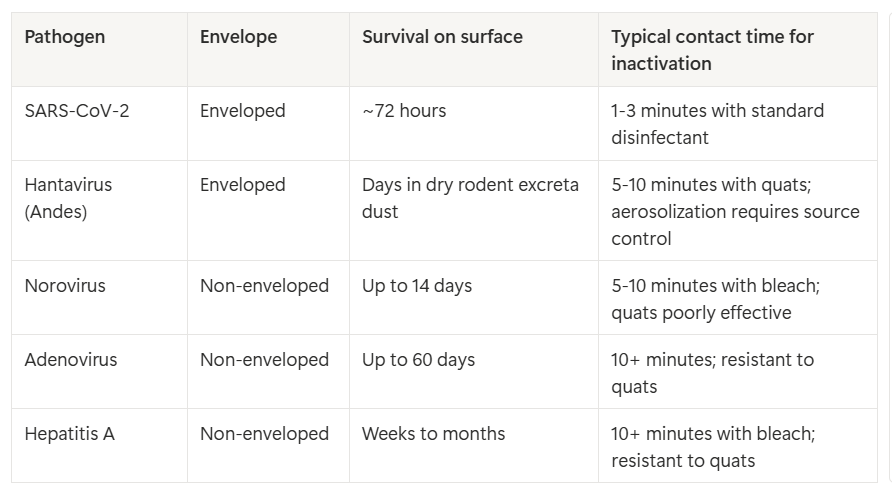
Contact times based on labels of disinfectants registered with regulatory agencies. Real efficacy depends on whether the contact time is met in operation, not only on whether it's printed on the label.
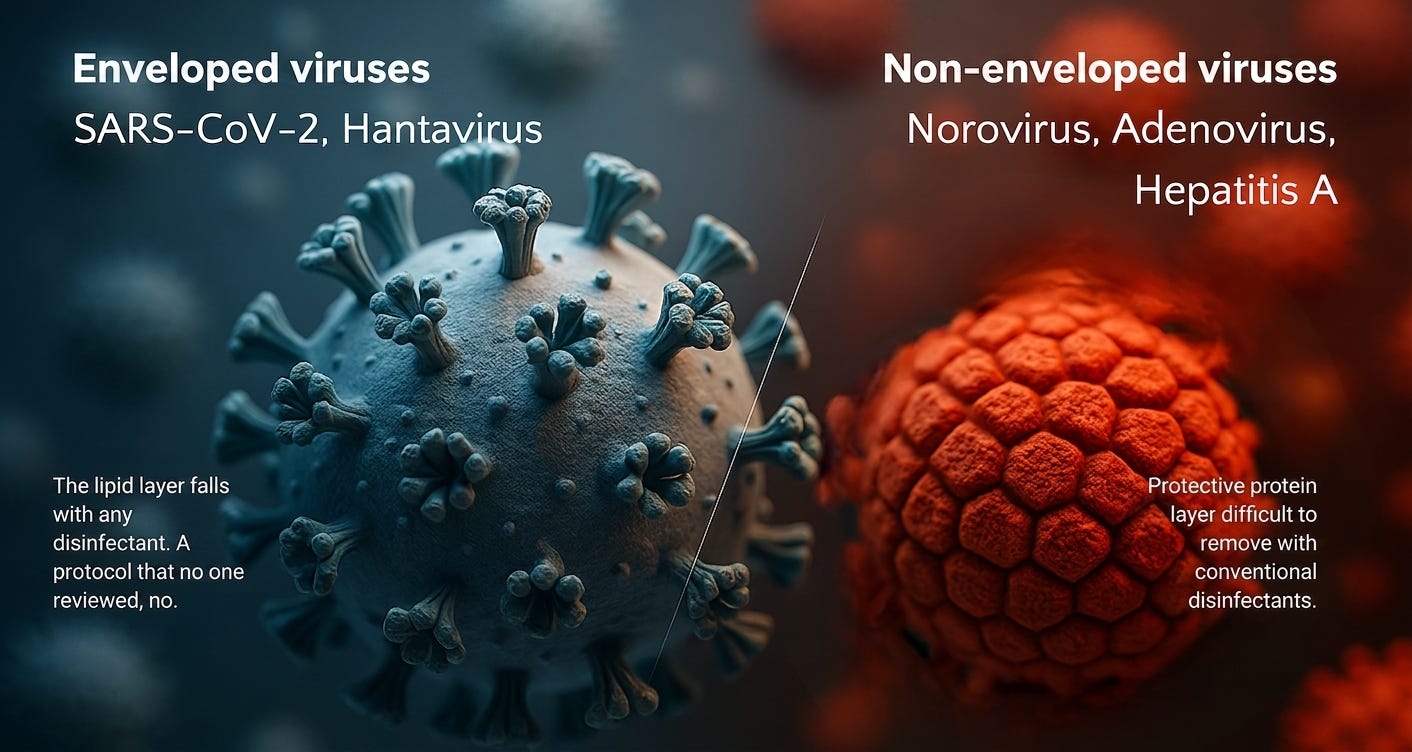
Viruses divide into two groups by the presence or absence of an external lipid envelope. Enveloped ones, like SARS-CoV-2 or hantavirus itself, are fragile in the face of detergents, alcohols, organic acids. Their fat layer breaks down with relative ease. Non-enveloped ones, like norovirus, adenovirus, hepatitis A, are armored. Norovirus can survive up to fourteen days on a stainless steel surface. Adenovirus, up to sixty. The difference matters because products that kill one don't necessarily kill the other.
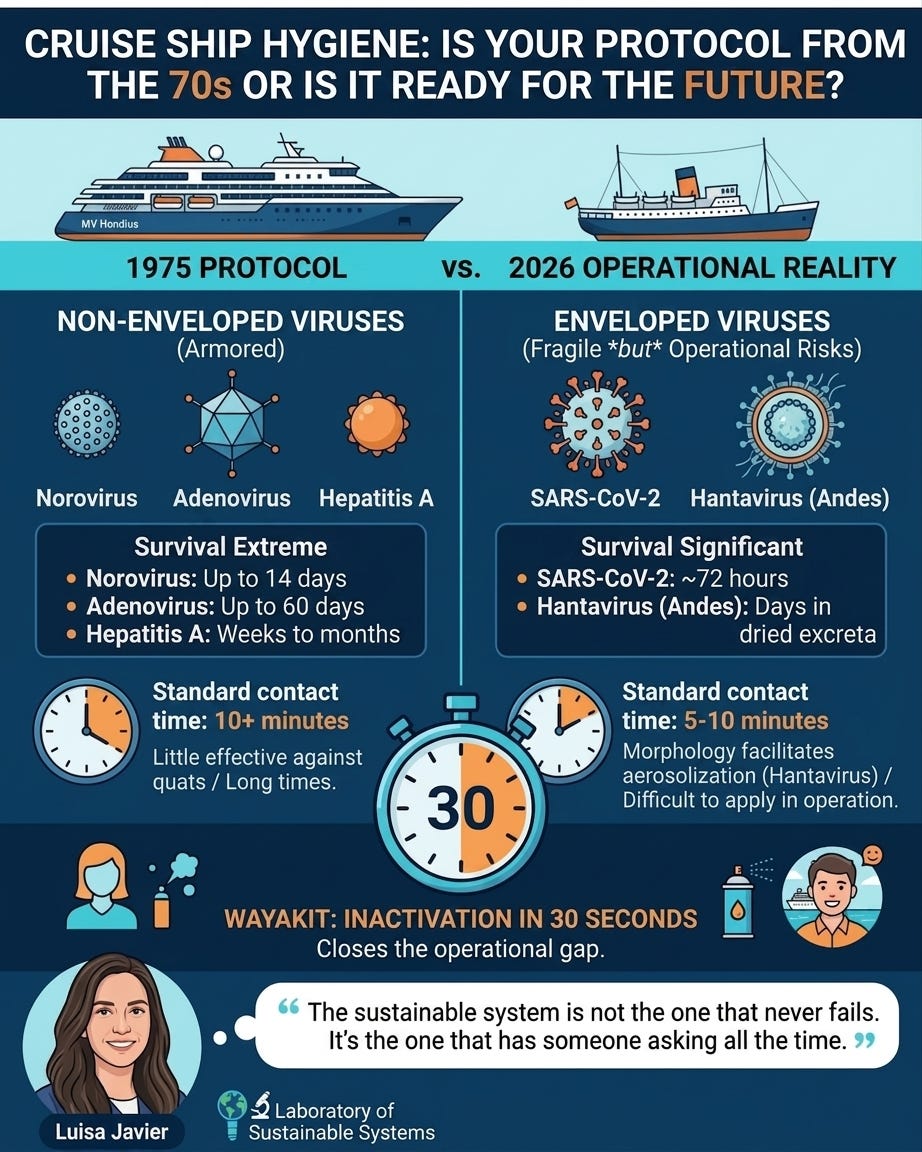
Hantavirus is enveloped. That matters. It means it’s theoretically vulnerable to almost any decent disinfectant. But its mode of transmission changes the calculation. The virus travels in dry rodent excreta dust. When someone sweeps, vacuums, or shakes, the virus aerosolizes and enters through the airways. Available chemistry deactivates it. Common operations disperse it before touching it.
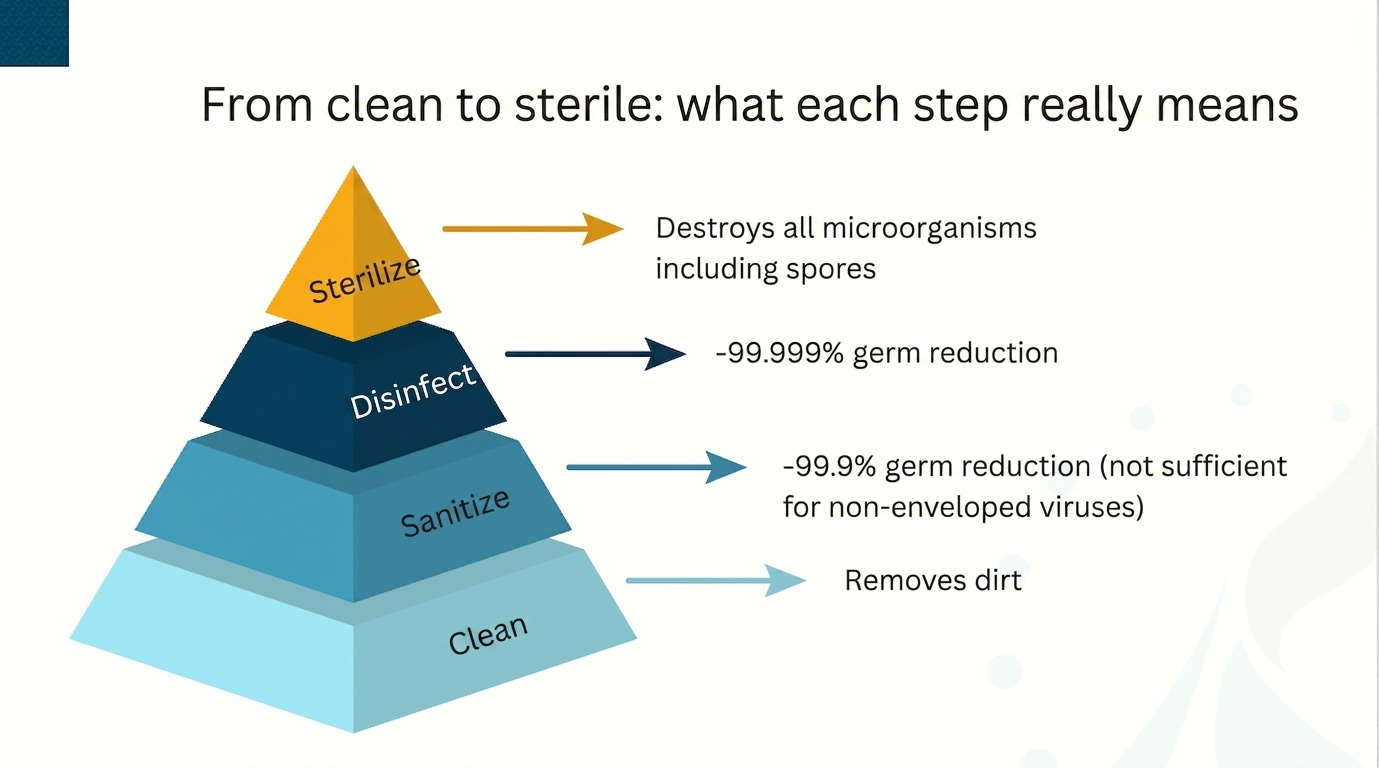
There’s a pyramid I teach when I talk about this. Cleaning removes dirt. Sanitizing achieves a 99.9 percent reduction. Disinfecting reaches 99.999. Sterilizing erases everything. The difference between sanitizing and disinfecting looks small in percentage. It isn’t. For a virus like norovirus, where eighteen particles are enough to make a person sick, the difference between 99.9 and 99.999 is the difference between hundreds of residual particles and units. The difference between a contained outbreak and a runaway one.
Then there’s contact time. The label of a quaternary ammonium disinfectant, the famous quats that dominate the industry, calls for ten minutes of wet contact to reach its declared efficacy. The operational reality is different. A cabin attendant has ninety seconds per surface, sometimes less. The product is applied, dries before completing the cycle, gets wiped. The protocol on paper says 99.999. Operational reality is probably 99 or less. This isn’t the cabin attendant’s fault. It’s system design that assumes conditions that don’t exist.
Epidemiologist Katelyn Jetelina, who writes Your Local Epidemiologist, asked the right questions in early May. Where the passengers got infected. What excursion, what pre-boarding exposure, what the cases have in common. The questions she asks are operational, not theoretical. And they reveal something worth naming: epidemiologists aren’t asking chemistry whether it works. They’re asking the system whether the chemistry was applied where it should have been, when it should have been, for as long as it should have been.
Let me tell you from the inside. In aviation, where we’ve been working for years, we’ve found that many clients have already migrated to our product. But when we run on-board application audits, we find trays that the product never even reaches. The chemistry has been bought. The application doesn’t happen. They went through the training module, signed the contract, paid for the supply. And still there are surfaces the staff never touches, because shift time runs out or the protocol doesn’t contemplate that specific zone.
When the operational system doesn’t follow the chemistry, the chemistry has no way to deliver.
The problem is not the chemistry available. It’s the attention available.
When the buyer only asks about cost
In the first piece I closed with a line worth bringing back here. Cost is paid by whoever has the least voice in the decision. The daycare that cleans on a household budget, that cost is paid by the children who get sick. The cruise that cleans on a savings protocol, that cost is paid by the passengers who trust.
During the pandemic, talking about contact time in a proposal to an airline or a cruise line was the first advantage we showed. It worked. Buyers understood the argument because collective urgency made them understand it. In 2021, WAYAKIT signed a partnership with Saudi Ground Services (SGS) for sustainable aircraft cleaning across Saudi Arabia. The case documented increased efficacy, reduced operational costs, and improved sustainability simultaneously. Three axes in one validation. The industry read it.
Today, in 2026, that same argument no longer enters the procurement room. My sales team reports the conversation: they explain the time savings, the toxicity reduction, the expanded efficacy against non-enveloped viruses. The buyer listens and always returns to the same question. And the cost? And the cost? And the cost?
When someone asks about cost three times in a row, they’re not asking the price. They’re telling you nothing else interests them. The regulation of chemical products lives the same cycle. Activist Lindsay Dahl, who writes about environmental health policy in the United States, documented a few weeks ago how an entire generation of chemical protections was dismantled in fifteen months since 2025.
The pattern repeats at the institutional level. The CDC’s Vessel Sanitation Program, founded in 1975 to inspect cruise ships docking at U.S. ports, lost key staff during 2025 and its director retired the week of the Hondius outbreak (STAT, May 7, 2026). The Hondius, operated by the Dutch company Oceanwide Expeditions and sailing under Dutch flag, never fell under that jurisdiction. But the temporal coincidence between institutional emptying and the outbreak is the postcard of the moment: when collective attention drops, biosecurity networks loosen in silence.
How do you talk to a buyer in 2026 about a risk they live as past? How do you name a danger that technically is still there, but that socially has been archived? The honest answer is that you don’t talk to them about the risk. You talk to them about what the current system isn’t ready to handle the day the next thing arrives. That day always arrives. The Hondius only confirmed it this week.
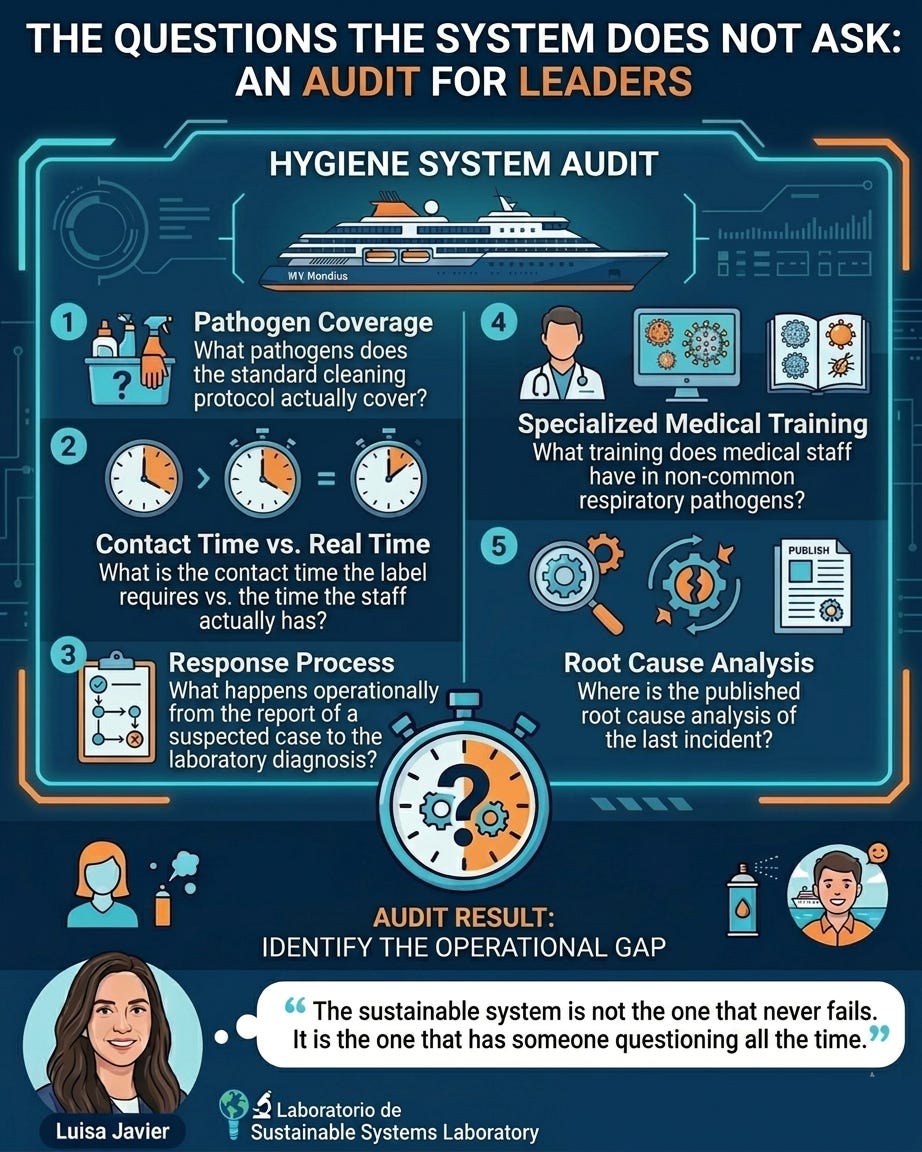
The questions the system doesn’t ask
I’m not going to give you a list of what to do. What helps more is a list of questions the system isn’t asking itself, and that any leader can start asking their own.
What pathogens does the standard cleaning protocol actually cover?
What’s the contact time the disinfectant label requires, and what’s the contact time the operational staff actually has on shift?
What happens operationally from the moment a suspected case is reported until a laboratory diagnosis arrives?
What training does the on-board medical staff, or in a building, or in a clinic, have in pathogens that aren’t common respiratory ones?
Where is the published root-cause analysis of the last incident?
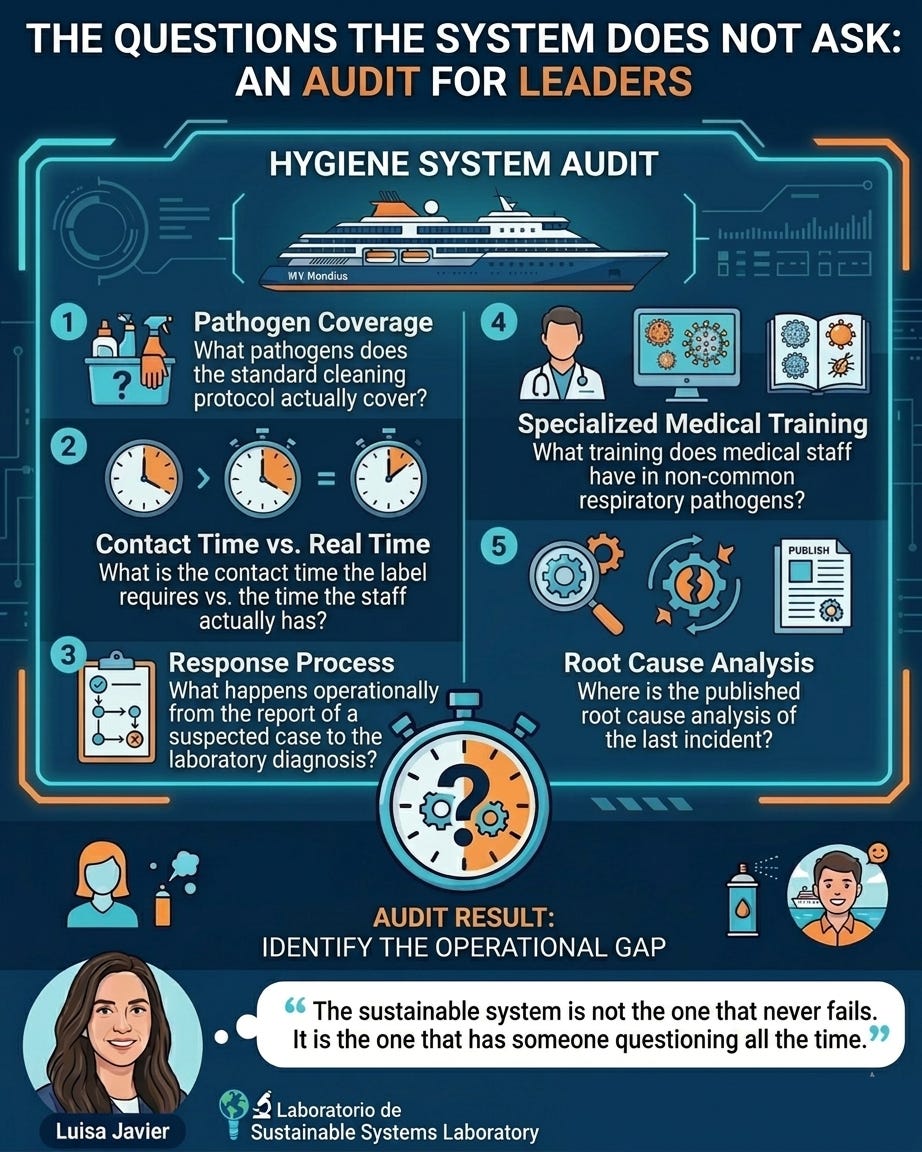
These questions aren’t just for cruise operators. They’re the audit any leader can run on their own system. The office, the school, the hospital, the factory, the hotel chain. Every closed space where someone trusts their health to a system they can’t see. The cruise works as metaphor, but the audit is the skill you take with you to any closed system you run.
The sustainable system isn’t the one that never fails. It’s the one with someone always asking what the system isn’t asking itself.
When was the last time you audited what’s invisible in your operation?
Subscribe to Aziul Connections (The Sustainable Systems Lab)
Public lab studying sustainable systems across business, leadership, and life. Essays, experiments, field observations and case studies from a climate-tech founder (Dr. Luisa Javier) operating between LATAM and MENA. Aziul = Azul (the planet) + Luisa (backwards)
About the author - Dr. Luisa Javier
Dr. Luisa Javier is a scientist and climate-tech entrepreneur across LATAM & MENA, focused on designing sustainable systems for business and society. She is the Founder and CEO of WAYAKIT Group and the author of Aziul Connections.
Aziul Connections is the public lab where I study how sustainable systems are built.
“I build sustainable living through WAYAKIT, and study the systems behind it through Aziul Connections.”
Thank you for reading or listening to this article, share it or leave a comment if you find this information useful!
Luisa
Connect with me
LinkedIn · Instagram · Facebook · Snapchat · TikTok
Formal references
World Health Organization. Hantavirus cluster linked to cruise ship travel, Multi-country (DON599). May 4, 2026. https://www.who.int/emergencies/disease-outbreak-news/item/2026-DON599
Aziul Connections, Piece 1 of the series. The Invisible Infrastructure That Decides Whether Your Child Gets Sick This Week. https://www.aziulconnections.com/p/invisible-infrastructure-hygiene-public-health
Jetelina K. Hantavirus, allergies and common cold. Your Local Epidemiologist, May 5, 2026.
Dahl L. A Generation of Chemical Safety Progress, Undone in 15 Months. The Environmental Health Brief, April 2026.
McGoldrick S. Health authorities work to contain cruise ship hantavirus outbreak. The Conversation, May 7, 2026. https://theconversation.com/health-authorities-work-to-contain-cruise-ship-hantavirus-outbreak-282343
Maillard JY et al. Reducing antimicrobial use and resistance in healthcare environments through improved cleaning and disinfection. Antimicrobial Resistance & Infection Control, 2023. [DOI pending]
Hall AJ et al. Norovirus disease in the United States. Emerging Infectious Diseases, 2016. [DOI pending]
Maes P et al. Evaluation of the efficacy of disinfectants against Puumala hantavirus. https://pmc.ncbi.nlm.nih.gov/articles/PMC7185759
CDC. Vessel Sanitation Program: Environmental Public Health Standards. 2025. https://www.cdc.gov/vessel-sanitation/media/pdfs/2025/06/2025_VSP_Environmental_Public_Health_Standards-508.pdf
STAT News. Top official retires from CDC cruise ship program amid hantavirus outbreak. May 7, 2026. https://www.statnews.com/2026/05/07/luis-rodriguez-retires-cdc-vessel-sanitation-program-amid-hantavirus-outbreak