


Key Points
I was taking notes for my closing remarks and realized I was writing the same sentence again.
Five panelists, five different topics, none of them coordinated. And all five were describing the same structure.
The sustainability you defend as a report is the first thing cut when the budget tightens.
The one that survives is the one embedded as operating logic, not as a compliance line.
The question isn’t whether you can invest in resilience. It’s whether you can afford not to.
👋 Hi, it’s Luisa Javier. Welcome to Aziul Connections ( 🌎🔬The Sustainable Systems Lab), where I study how sustainable systems are built for business, leadership, and life.
🎧 Listen to Luisa read this article
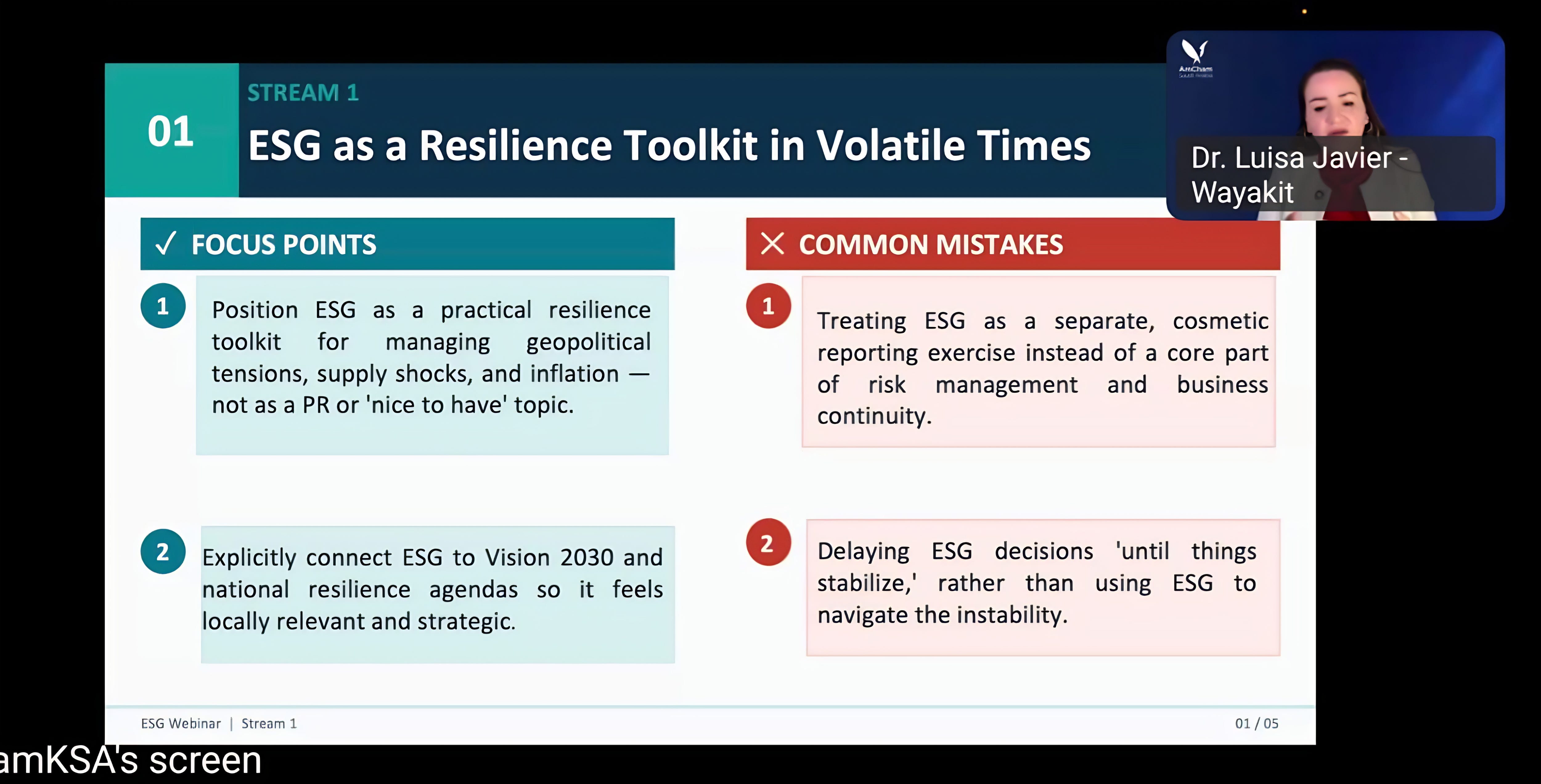
Last Wednesday, the AmCham Saudi Arabia ESG committee ran a webinar called ESG in Action: Building Resilience in Challenging Times. I have been part of that committee since 2022, and this webinar marked the close of my term. I opened the first stream, on ESG as a resilience toolkit, and I was also asked to close the full session with the key points from all five topics.
So, during the four interventions that followed mine, I was taking notes. One sentence per stream. Supply chain, governance, workforce wellbeing, finance. Four separate topics, designed to be explored each on its own, without overlapping.
Somewhere between the second and third panelist, I looked down at my page and realized I was writing almost the same sentence again. Not because they were repeating each other. Because without coordinating it, they were arriving at the same place by different roads.
What I felt wasn’t exactly relief. It was something more uncomfortable. If five people who never compared notes end up describing the same structure, then the thing I thought was my thesis is bigger than me. I was only just naming it.
What each person brought to the table without knowing what the others were bringing
The supply chain panelist talked about something technical: the risk of depending on a single supplier. And in the middle of his explanation he said, almost in passing, that meeting sustainability criteria ends up protecting the company. He didn’t frame it as a cost, but as insurance.
The governance panelist built his whole framework around three words: reputation, resilience, recovery. And he left one sentence that stayed with me. A crisis is not a pause on a company’s values. It’s the real test of whether those values were ever there.
The workforce wellbeing panelist brought two things to the table: treating social responsibility as part of business continuity, not as a separate program, and naming the mistake of cutting safety, training, and wellbeing first when costs rise, assuming they can be rebuilt later. What gets treated as expendable is the first thing to go. And it rarely gets rebuilt the same.
The finance panelist, at the end, made his own list of reasons not to cut sustainability when money tightens. And he closed by saying the only way it works is if resilience is embedded inside.
Five people talking about five different things, and none of them were talking about a report. All of them were talking about what holds you up when the ground moves.
Why this matters if you’re in your own room
You probably weren’t in that webinar. But you’re in some version of that room.
You’re the person who at some point will have to sit across from whoever decides the budget and defend why sustainability doesn’t get touched. And the observation from that webinar is useful to you for one concrete reason: it tells you where the real test is.
It’s not in the report. The report is what looks presentable in a good season. The real test comes when the season turns hard: whether the discipline is still there, or not. A study published in Oxford’s Review of Corporate Finance Studies found that during the market collapse in early 2020, companies with stronger environmental and social practices fell less and recovered better than their peers. Not because they had a better report. Because they had something built on the inside that didn’t come apart under the hit.
The sustainability you defend as compliance is the first thing cut. The one that becomes a way of operating is the one that keeps you standing.
The question left on the table
When it was my turn to close, I didn’t summarize the five streams. I asked a question, because it was the only honest thing I could do with what I had just seen.
The question was this: what if we take sustainability as the operating logic of survival itself? Not as a department. Not as a section of the annual report. As the way the company decides, every day, in operations, in procurement, in governance, in finance.
And from there comes the harder question, the one I really want to leave with you. We almost always frame it backwards. We ask whether we can afford to invest in sustainability when times are hard. But after that hour and a half listening to four people reach the same point without coordinating, the right question flipped on me. It isn’t whether you can afford to invest in resilience. It’s whether you can afford not to.
What I took from the conversation
I didn’t take the five topics. I took the pattern underneath the five topics.
When several people who never coordinated end up describing the same thing, it isn’t coincidence. It’s that they were touching something structural, something that was there before any of them opened their mouth.
So, the next time you’re in a meeting, across from whoever decides, with the budget tightening: look at what you’re defending. If you defend a line in the report, you’ll lose, and you’ll be right to lose it. If you defend the thing that keeps your company standing when the ground moves, that’s a different conversation. That one you can win.
Subscribe to Aziul Connections (The Sustainable Systems Lab)
A public lab studying sustainable systems in business, leadership, and life. Essays, experiments, field observations, and case studies from a climate tech founder (Dr. Luisa Javier) operating between LATAM and MENA. Aziul = Azul (the planet) + Luisa (reversed)
About the author: Dr. Luisa Javier
Dr. Luisa Javier is a climate tech scientist and entrepreneur across LATAM and MENA, focused on designing sustainable systems for business and society. She is Founder and CEO of WAYAKIT Group and author of Aziul Connections.
Aziul Connections is the public lab where I study how sustainable systems get built.
“I build sustainable life through WAYAKIT, and I study the systems behind it through Aziul Connections.”
Thank you for reading or listening to this article. Share it or leave a comment if you find this useful.
Luisa
Thanks for restacking Petar