


Key points
I opened a new bag of kibble, gave it to only one of my three dogs, and he got seriously sick.
I never found out what it was. And I design sanitation systems for a living.
Kibble is cooked above 92°C, hot enough to kill Salmonella. The blind spot comes after the heat.
Once contaminated, Salmonella survives up to 19 months in dry kibble at room temperature.
Here are the four places where your hygiene system fails without giving you a single symptom.
👋 Hi, I'm Luisa Javier. Welcome to Aziul Connections (🌍🔬 The Sustainable Systems Lab), where I study how sustainable systems get built for business, leadership, and life.
🎧 Listen to Luisa read this article
The new bag
I have three dogs. One afternoon I opened a new bag of kibble and, the way the day went, only one of them ate from that bag. Within hours he was sick. Badly sick. The other two, who never touched it, went on like nothing happened.
I threw out the whole lot without thinking twice. And I was left with a question I couldn’t close: what exactly was it.
I didn’t send it to a lab. I don’t have the name of the pathogen. I only have the consequence, one sick dog, and a correlation, the new bag. And here is the uncomfortable part. I design sanitation systems for plants and aviation. I know how a pathogen moves across a surface better than most dog owners do. And still, I didn’t catch it in time.
That is the part I want to hand you today, as a tool. Because whatever made my dog sick left no signal I could read. This kind of failure is built that way: it fails silently.
Why “dry and processed” does not mean safe
Here is the belief we have to break first. Most people assume dry kibble is safe because it goes through heat. And that is half true, which is the worst kind of true.
Kibble is produced by extrusion at temperatures lethal to Salmonella, and that step is validated as a critical control point that reduces pathogens sharply, according to research published in the International Journal of Food Microbiology. Up to that point, the system works.
The problem is what happens next. After extrusion, the kibble gets coated with fats and flavorings that go through no pathogen reduction treatment at all. There is no standardized post-processing mitigation step in dry kibble production, according to a 2024 review in Comprehensive Reviews in Food Science and Food Safety. The coating step is the main entry point for the pathogen into the finished product. Just like in other food safety systems, the failure is not in the strong, visible step. It is in the quiet step that comes after.
Heat is not the blind spot. The blind spot is everything that touches the product after the heat.
And once it gets in, it stays. Once contaminated, Salmonella can survive up to 19 months in dry kibble stored at room temperature, according to the same body of research. It does not grow, because the low water activity won’t let it. But it persists, alive, invisible, for nearly two years inside a bag that looks perfect.
Why the invisible spreads
Here is the background that would have helped me that afternoon, in dog-owner language, not lab language.
Salmonella doesn’t need to make an animal sick in order to travel. A dog can carry it in his gut, look perfectly healthy, eat with appetite, and still be leaving it on the floor, in the bowl, on the bag, on the hand that pets him. This is called an asymptomatic carrier, and it is the reason this pathogen is so good at moving without anyone noticing. The animal that looks fine is not always the good news; sometimes it’s the one spreading what you can’t see. And the jump to the human is short: the person who opens the bag, serves the kibble, and doesn’t wash their hands well enters the same chain. Salmonella in pet food is also a problem for the person handling it.
The animal that looks fine is not always the good news. Sometimes it’s the one spreading what you can’t see.
In a home, this is a scare. In a food plant or a veterinary clinic, where one surface touches the next hundreds of times a day, it’s a lost lot, a recall, a sick client, your reputation. Recall analysis only shows what was tested and caught; what passes undetected shows up in no statistic. By the time there is a symptom, it has already spread.
The four sanitation blind spots
These are the four places where a hygiene system fails without giving symptoms. They are not theory. Each one matches a documented failure mode. Run this list over your own operation, whether it’s a plant, a clinic, or your kitchen.
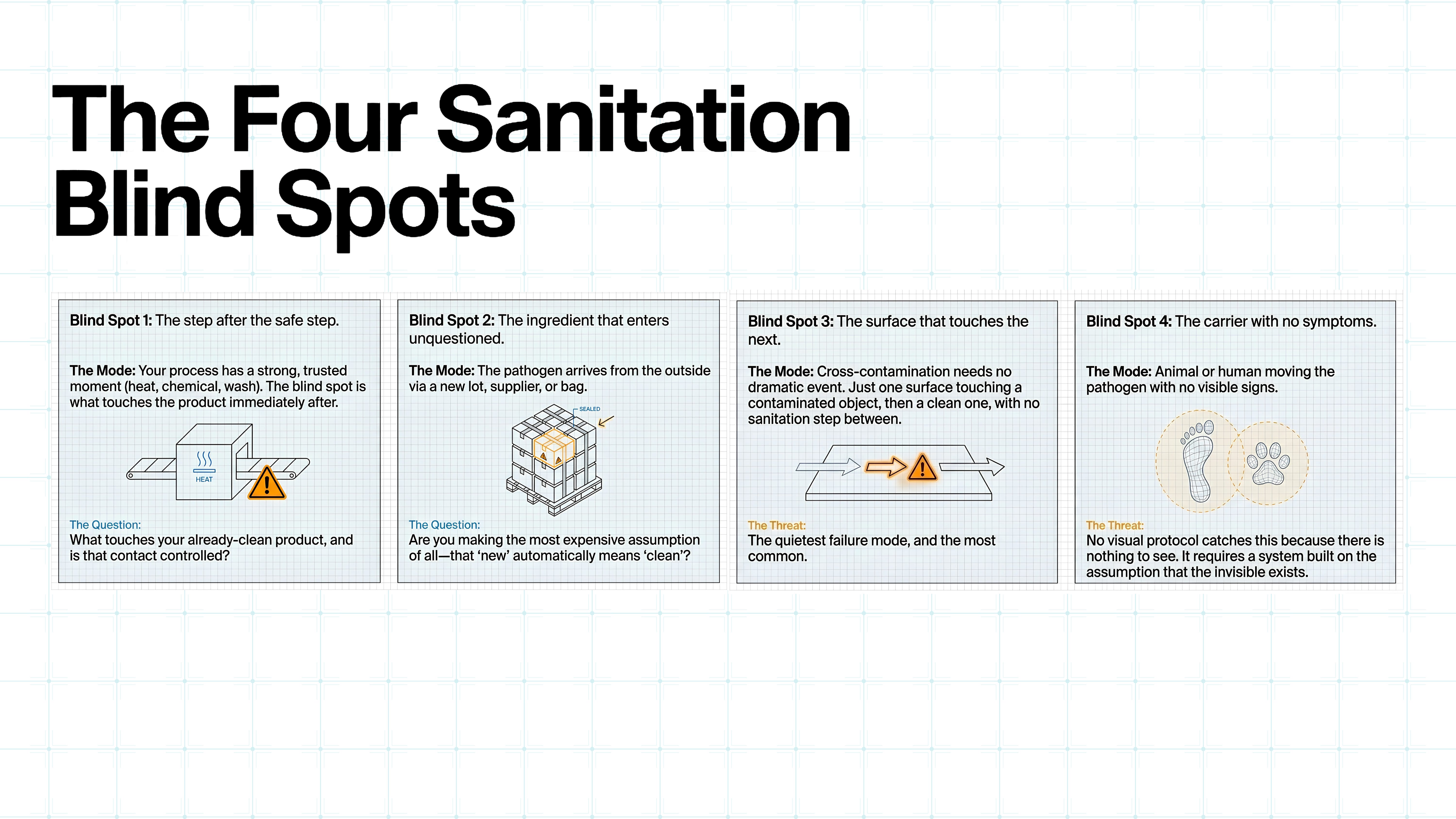
Blind spot 1. The step after the safe step. Your process has one strong moment, the heat, the chemical, the wash. You trust it, and you should. The blind spot is always what touches the product after that moment. In kibble it’s the coating. In your operation, ask yourself: what touches the already-clean product, and is that contact controlled.
Blind spot 2. The ingredient or lot that enters unquestioned. The pathogen isn’t always born inside. Sometimes it arrives in something new that enters the system without review, a lot, a supplier, a bag. The assumption that new means clean is the most expensive one of all.
Blind spot 3. The surface that touches the next. Cross-contamination doesn’t need a dramatic event. It needs one surface that touched something contaminated and then touches something clean, with no sanitation step in between. It’s the quietest failure mode and the most common.
Blind spot 4. The carrier with no symptoms. Animal or human, someone moving the pathogen with no visible sign. This is the one no visual protocol catches, because there is nothing to see. It is only caught by a system that assumes the invisible exists.
A protocol checks what you can see. A system catches what you can’t.
The blind spot is yours before you need it
You don’t have to solve all four today. Find the first one where you hesitated as you read it. That’s your blind spot. That’s where the system you think you have doesn’t exist yet, where it’s still just a protocol.
I threw out a lot and was left with no answer, because I never designed the system to catch what shows no symptoms. You are still in time to design the question before you need the answer.
Of the four, which one is yours?
Subscribe to Aziul Connections (The Sustainable Systems Lab)
A public lab studying sustainable systems in business, leadership, and life. Essays, experiments, field observations, and case studies from a climate tech founder (Dr. Luisa Javier) operating between LATAM and MENA. Aziul = Azul (the planet) + Luisa (reversed)
About the author: Dr. Luisa Javier
Dr. Luisa Javier is a climate tech scientist and entrepreneur across LATAM and MENA, focused on designing sustainable systems for business and society. She is Founder and CEO of WAYAKIT Group (sa.wayakit.com) and author of Aziul Connections.
Aziul Connections is the public lab where I study how sustainable systems get built.
“I build sustainable life through WAYAKIT, and I study the systems behind it through Aziul Connections.”
Thank you for reading or listening to this article. Share it or leave a comment if you find this useful.
Luisa
Connect with me
LinkedIn · Instagram · Facebook · Snapchat · TikTok
References
Lambertini, E. et al. (2016), “Modeling the long-term kinetics of Salmonella survival on dry pet food,” International Journal of Food Microbiology, Vol 227, pp 41-50. (Currency note: 2016 source; the survival mechanisms described remain current in the 2024 literature, see reference 2.)
Dhakal, J. et al. (2024), “Salmonella Presence and Risk Mitigation in Pet Foods,” Comprehensive Reviews in Food Science and Food Safety, Vol 23.
Deibel Laboratories (2023), “Salmonella Contaminated Dry Pet Food Causes Outbreak and Nationwide Recall.”