


Highlights
Latina in an Arab community, Muslim in a Latina community. Fernanda belonged to neither side.
When you belong nowhere, the strongest temptation is to earn your place by doing more. It’s a trap.
“My identity was based on what I did.” The day you stop doing, you stop being. And a bad day always arrives.
She came out in three movements: pause, return to being, reconcile the roots. Presence helped. She built the system.
“Reverse the order. Instead of starting from doing, start from being.” Fernanda learned this at 24. You can start tomorrow.
👋 Hi, it’s Luisa Javier. Welcome to Aziul Connections ( 🌎🔬The Sustainable Systems Lab), where I study how sustainable systems are built for business, leadership, and life.
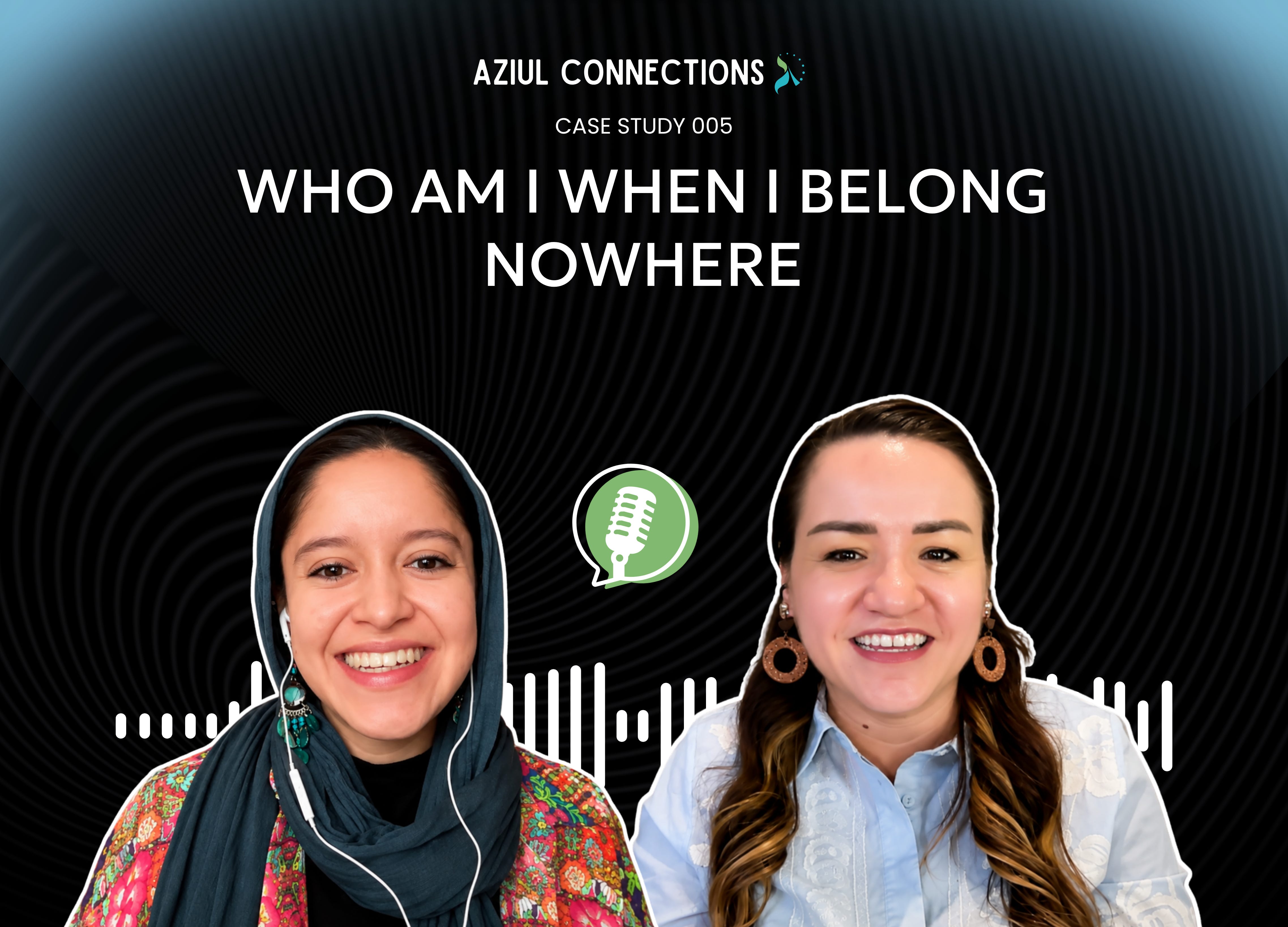
🎧 Listen to the full interview with Fernanda Peñaherrera
There is a question almost no one dares to ask out loud: who am I when I belong nowhere?
Fernanda Peñaherrera had to answer it twice before turning 24. The first time she answered without a system. The second time she had one. That is why she is here.
Fernanda is Ecuadorian, lives in Riyadh, converted to Islam at 21, is married to a Yemeni man, founded Ssuubi (a humanitarian project in Uganda) and is expecting her first baby. But none of that is the system. That is the context. The system comes from inside.
“Did you have another crisis?” “A bad one.”
When Fernanda converted to Islam, she thought the confusion was over. She was wrong.
“I felt very alone. I felt like no one understood me”, she says of the period right after. Family supported her. Old friends stayed at a distance. New friends did not exist yet. And in that empty space an old wound came back, one she already knew from high school: trying to belong by doing more.
When you belong nowhere
Fernanda was caught between two communities that refused to recognise her fully.
“Latinos criticize me and minimize me for being Muslim. And at the same time, the Arab community minimizes me for being Latina.”
This is not Fernanda’s personal problem. It is a documented pattern. A study published in Frontiers in Psychology on bicultural identity shows that people living between two cultures often experience simultaneous rejection from both sides, and that double rejection is one of the strongest predictors of identity crisis in young adults.
The problem with belonging nowhere is that the only exit that seems logical is: earn your place.
The trap of belonging by doing
Fernanda names it plainly:
“My identity was based on what I did.”
This sounds admirable. It sounds like an ambitious, productive, purposeful woman. And she was all of those things. But the problem is mathematical: if your identity depends on what you do, the day you stop doing, you stop being. And a day when you cannot do always arrives. Burnout, illness, a mistake, pregnancy, any of it. On that day you do not just lose your productivity. You lose yourself.
The movement of return
Fernanda came out in three movements, not one. They were not clean steps. They overlapped. But the order matters.
First, pause. Not run. Not search for the next community to belong to. Just stop. Fernanda decided to step away from both communities that were confusing her. She said something that costs a lot to say: “I prefer to be alone and feel alone than to be with people who are making me confused.”
Second, return to being. This is where her pilgrimage to Mecca played a role, though she clarifies it herself: “I’m not going to say that every time someone is in a crisis they should go on pilgrimage to Mecca. That’s not realistic.” What that trip gave her was a structured pause and an anchor that did not depend on anyone else’s opinion.
Third, reconcile the roots. Meeting her husband (Yemeni) helped her stop fighting with her Latina identity. He told her: “I love your culture. Teach me more.” Fernanda started to understand she did not have to pick between two worlds. They could coexist.
She closed the system herself, near the end of the conversation, like someone handing over the key:
“Reverse the order. Instead of starting from doing, start from being.”
That is the sentence that holds the system. It is not new. Others have said it in other ways. But Fernanda learned it by living through it twice before turning 24.
Three questions to start tomorrow
Who are you when you do not do?
Which community asks you for constant proof of belonging?
If you paused everything you are doing today to fit in, what would be left?
These are not questions to answer fast. They are questions to answer alone.
What else we talked about
There are three moments in the conversation with Fernanda that did not fit in this article but are worth listening to in the audio: her work with Ssuubi in Uganda, her encounter with a Bedouin girl named Islam in the Wadi Rum desert, and how she learned not to accept online hate as a gift that isn’t hers.
Follow Fernanda
Personal Instagram: @fernanda.penaherrera
Ssuubi: @s.suubi
To go deeper
Henríquez D., Urzúa A., López-López W. (2021). “Acculturation Profiles and Mental Health Among Immigrants and Native-Born Adolescents.” Frontiers in Psychology. Study on bicultural identity and double rejection: pmc.ncbi.nlm.nih.gov/articles/PMC8565597
Subscribe to Aziul Connections (The Sustainable Systems Lab)
Public lab studying sustainable systems across business, leadership, and life. Essays, experiments, field observations and case studies from a climate-tech founder (Dr. Luisa Javier) operating between LATAM and MENA. Aziul = Azul (the planet) + Luisa (backwards)
About the author - Dr. Luisa Javier
Dr. Luisa Javier is a scientist and climate-tech entrepreneur across LATAM & MENA, focused on designing sustainable systems for business and society. She is the Founder and CEO of WAYAKIT Group and the author of Aziul Connections.
Aziul Connections is the public lab where I study how sustainable systems are built.
“I build sustainable living through WAYAKIT, and study the systems behind it through Aziul Connections.”
Thank you for reading or listening to this article, share it or leave a comment if you find this information useful!
Luisa